Written by Metin KARAL – Computer Engineer with 25+ years of experience in internet technologies. Some products here are tested directly, while others are evaluated through detailed research, specifications, and verified customer feedback. This article may contain affiliate links; as an Amazon Associate we earn from qualifying purchases at no extra cost to you.
Every car charger box says “fast charging for iPhone and Samsung” — but those are two different technologies wearing the same label. iPhones run on standard PD. Samsung phones need PPS layered on top to actually hit Super Fast Charging, and most listings that claim Samsung compatibility never mention whether PPS is even present. We checked the spec sheet on every charger here, not just the marketing bullets, so you’ll know exactly which protocol you’re getting before you buy — plus one honest reminder: a car charger’s job is a quick top-up during your commute, not a full charge, so don’t judge these against your wall charger’s numbers. 10 picks below, each one built for a specific driver, not a generic “best overall.”
Best Car Chargers for iPhone & Samsung (2026)
| Charger | Why |
|---|---|
| Belkin BoostCharge 42W | Best Overall – Verified PD 3.1 + PPS (3.3-11V/2.72A), tested charge times for iPhone (21 min to 50%) and Samsung (26 min to 50%), included cable, $2,500 Connected Equipment Warranty. |
| AINOPE 108W 6-Port | Best Multi-Device Family – Six independent ports split between front and rear seats via a 5-foot cable, UL certified housing, designed for multiple simultaneous passengers. |
| ESR OmniLock Qi2.2 | Best Wireless MagSafe Mount – Qi2.2 wireless charging up to 25W, CryoBoost active cooling, N52 magnets, detailed per-device wattage breakdown. |
| UGREEN 130W | Best for Samsung – Dedicated 45W PPS port verified for Samsung Super Fast Charging, separate 100W port for laptops, genuine E-Marker cable included. |
| Anker 323 52.5W | Best for iPhone – PowerIQ 3.0 with a verified 25-minute iPhone charge time to 50%, ActiveShield 2.0 protection, nearly 9,000 reviews. A proven PD charger built for iPhone-first households. |
| KENHAO 67W | Best Budget for iPhone – Genuine 37W PD charging at the lowest price in this roundup, included cable. Real iPhone speed without paying for Samsung hardware you wouldn’t use. |
| UGREEN 63W | Best Budget for Samsung – 45W PPS (3.3-11V/4.05A) at under $20 — one of the only sub-$20 chargers here with genuine, verifiable Samsung Super Fast Charging. |
| UGREEN 145W Retractable | Best Retractable Cable – Built-in 70cm retractable cable, independently verified 33W PPS, plus a 100W port for laptops. The most practical cable-management solution in this roundup. |
| Anker 167.5W 3-Port | Best for MacBook/Laptop + Phone – Verified 100W laptop port plus a 45W secondary port, each with independent power budgets. The only charger here built to fast-charge a MacBook and a phone together. |
| LISEN 84W Retractable | Most Popular Pick – Two built-in retractable cables (USB-C and Lightning), honest PD-only listing with no overstated Samsung claims. The current #1 best-selling car charger on Amazon. |
Belkin BoostCharge 42W Dual Port Car Charger — Best Overall

Quick Facts
- 🔌 30W USB-C + 12W USB-A — two devices, two genuinely useful speeds
- 🔗 PD 3.1 certified + PPS 3.3-11V/2.72A — verified, documented protocol support, not a marketing number
- 📱 iPhone: 0-50% in 21 minutes — Belkin’s own tested figure for 30W optimal charge
- 📱 Samsung: 0-50% in 26 minutes — real PPS-backed Super Fast Charging, not just PD fallback
- 📦 Cable included — 3.3ft USB-C to USB-C, no separate purchase needed
- 🌱 Eco-conscious build — post-consumer recycled materials, plastic-free packaging
- ✅ $2,500 Connected Equipment Warranty — Belkin repairs or replaces your phone if it’s damaged while properly connected
Editor’s Note
Most dual-brand car chargers hedge. They print one big combined wattage and let you guess how it splits between an iPhone and a Samsung. Belkin didn’t do that here — the spec sheet lists a separate tested charge time for each phone, and backs it with an actual PPS voltage range instead of just the word “fast” on the box.
That specificity is what earned this Best Overall. A charger that says “30W max” is only half the story. A charger that says “30W optimal for iPhone, 30W PPS-negotiated for Samsung, tested at 21 and 26 minutes respectively” is telling you something you can actually verify. I went looking for the fine print on a lot of these listings this week, and most don’t have any — just a wattage number and a long device compatibility list.
What also stood out is the size. This is a genuinely small charger for what it delivers — a compact footprint that doesn’t eat half your dashboard console, paired with a cable already in the box so you’re not stuck using whatever cheap cord came with your last phone.
Pros
- Verified PPS, not just PD — most car chargers stop at PD and call it “fast charging.” A confirmed PPS range means Samsung phones actually reach their Super Fast Charging mode here, not just a slower fallback speed dressed up in marketing language.
- Tested, not estimated, charge times — Belkin published real 0-50% numbers for both an iPhone and a Samsung on this exact charger. That’s the difference between a spec sheet you can trust and one you’re taking on faith.
- A cable comes in the box — sounds minor until you’re the person digging through a glovebox for a working USB-C cord. One less thing to remember, and it’s rated to actually use the charger’s full speed.
- Small enough to forget it’s there — this doesn’t hog console space or block a second outlet, which matters more than it sounds like in a car with limited plug real estate.
- Belkin will pay if it damages your phone — the $2,500 Connected Equipment Warranty is a real financial backstop, not just marketing language. If a fault in this charger fries your phone, Belkin covers it.
Cons
- Won’t touch a laptop or tablet — this is built for phones. If you also want to charge a MacBook or iPad on road trips, look elsewhere on this list.
- Two ports means two people, not four — fine for a daily driver or couple, tight for a family car with multiple kids and devices.
- You’ll be managing a loose cable — no retractable mechanism here, so the cord lives loose in your console or cupholder like most chargers.
Does a car charger need to hit the same wattage as a wall charger?
No — and this is worth understanding before comparing specs. Car charging is a top-up, not a full charge. Most drives last 15-40 minutes, nowhere near the time needed for a full charge regardless of wattage. A charger that delivers real, verified 30W PPS during a commute is doing exactly its job — recovering meaningful battery percentage before you’re back at a wall outlet anyway.
Why We Liked It
I went into this batch of car chargers expecting the usual pattern — a big wattage number on the box, vague “fast charging” language everywhere else, and no way to actually verify what either phone gets. Belkin’s spec sheet broke that pattern immediately. It’s the only charger in this roundup that documents its PPS voltage range down to the decimal, rather than just slapping “Super Fast Charging compatible” on the listing and hoping nobody checks the fine print.
That transparency matters more than it sounds like. A charger claiming PPS support with no voltage range listed anywhere is asking you to trust a marketing bullet point. Belkin instead gives you the actual negotiation range — 3.3V to 11V, up to 2.72A — which is the same level of detail I’d expect from a datasheet, not a product listing. When I checked that against Samsung’s own PPS requirements for Super Fast Charging, it lined up. That’s not something I can say about most of the other chargers in this batch.
The tested charge times sealed it. Most listings give you one number and let you assume it applies to every phone equally. Belkin tested an iPhone and a Samsung separately and published both — 21 minutes to 50% for one, 26 for the other. Different numbers for different phones is exactly what you’d expect from someone who actually tested it, rather than someone who ran the math once and called it done.
For a roundup built specifically around honest iPhone-vs-Samsung charging claims, this is the charger that made the fewest promises it couldn’t back up — and that’s precisely why it earned the top spot.
Best For
Anyone who wants one charger that genuinely treats both an iPhone and a Samsung fairly — verified fast charging for each, in a compact, well-documented package.

Belkin BoostCharge 42W Dual Port Car Charger
Summary
The Belkin BoostCharge 42W earns Best Overall not by chasing the highest wattage number, but by being the most honest and verifiable charger in this entire roundup. Documented PD and PPS specs, tested charge times for both major phone ecosystems, and a cable in the box make this the pick I’d trust without needing to independently verify anything myself — which, after digging through this many listings, says a lot.
UGREEN 130W USB-C Car Charger — Best for Samsung Phones

Quick Facts
- 🔌 Ports: USB-C1 (PD 100W) + USB-C2 (PD 30W + PPS 45W) + USB-A (QC/SCP 22.5W)
- 🔗 Protocols: PD 3.0, PPS, SCP, QC — verified on official spec sheet
- ⚡ Total output: 130W combined across all ports
- 🧵 Cable: 3.3ft 100W USB-C cable included, E-Marker chip built in
- 🛡️ Certifications: UL tested, RoHS, CE, FCC
- 🔋 Input: 12V-24V — works in cars, SUVs, and trucks
- 💡 Extras: Blue LED port light, scratch-resistant PC housing
Editor’s Note
Samsung’s Super Fast Charging only activates when a charger negotiates PPS — a fixed-voltage PD charger will still charge a Galaxy phone, just noticeably slower than the phone is actually capable of. Most car chargers never mention PPS at all, which means a Samsung owner has no way of knowing whether they’re getting full speed or a quiet downgrade.
UGREEN doesn’t leave that to guesswork here. The listing calls out “Samsung Galaxy S24 Ultra (Supports 45W PPS)” by name, and the spec sheet backs it with an actual dedicated PPS port rather than folding it into a shared, best-effort output. That’s the detail that earns this the Samsung slot — it’s built with the intention of hitting Samsung’s fast-charging spec (including S26 Series) not just compatible with Samsung phones in the loosest sense of the word.
The second thing worth knowing: the 100W port and the 45W PPS port are separate. If you plug your Samsung into the wrong port, you won’t get Super Fast Charging — you’ll just get standard PD speed. It’s a small detail that’s easy to miss and genuinely changes your charging speed, so it’s worth checking which port is which before you plug in.
Pros
- A dedicated PPS port, not a shared one — the 45W PPS output has its own port, so it’s not competing for power with whatever else is plugged in.
- The listing names the exact phone it’s tuned for — calling out “S24 Ultra (Supports 45W PPS)” by name is a level of specificity most competitors skip entirely.
- A real E-Marker cable is included — this matters more than it sounds. A cheap cable without an E-Marker chip can silently cap your charging speed even if the charger itself is capable of more.
- Enough headroom for a laptop too — the 100W port can top up a MacBook or Windows laptop on a long drive, which most phone-focused car chargers can’t touch.
- UL tested, not just self-certified — third-party safety verification, which matters more in a car charger than almost any other electronics category given the constant vibration and heat exposure.
Cons
- Port confusion is a real risk — plug your Samsung into the 100W port instead of the dedicated PPS port, and you’ll lose Super Fast Charging without any indication why.
- No retractable cable — you’re managing the included cord loose, same as most chargers in this price range.
- Blue LED light can’t be turned off — a small thing, but worth knowing if you’re sensitive to lit-up gadgets on a night drive.
Does it matter which port I use for Super Fast Charging?
Yes — and this is the single most important thing to know before using this charger. Only the dedicated PPS port delivers Samsung’s full Super Fast Charging speed. The other USB-C port outputs standard PD, which will still charge your phone, just without the negotiated voltage curve that gets you to full speed. Check the charger’s port labeling before you plug in if speed matters to you.
Why We Liked It
Most car chargers treat “Samsung compatible” as a box to check, not a spec to hit. UGREEN’s 130W charger is one of the few in this entire batch that actually names the phone it’s engineering around and backs it with a dedicated port rather than a shared, best-effort output. That’s a meaningfully different approach than a charger that just lists Samsung in a giant device compatibility paragraph and hopes the wattage math works out.
What convinced me this deserved the Samsung slot specifically, rather than just a general “high wattage” pick, was the separation of ports. A shared PPS/PD port means the charger is guessing which protocol to prioritize. A dedicated port means it doesn’t have to guess — Samsung phones get routed to the exact voltage curve they’re asking for, every time, without competing against whatever else might be plugged into the charger at the same moment.
The included cable is the detail most reviews gloss over entirely. A charger can support 45W PPS on paper and still deliver a fraction of that if the cable bundled with it isn’t rated to carry it. UGREEN including a genuine E-Marker cable means you’re not accidentally bottlenecking the exact feature that makes this pick worth choosing over a cheaper alternative.
Best For
Samsung Galaxy owners — particularly Ultra and Plus models — who want verified, dedicated Super Fast Charging support in the car, plus enough spare capacity to top up a laptop on longer drives.

UGREEN 130W USB-C Car Charger
Summary
The UGREEN 130W earns Best for Samsung by doing what most car chargers only imply — actually engineering a dedicated path for Samsung’s Super Fast Charging protocol, verified down to the exact phone model on the spec sheet. The tradeoff is a bit of port confusion risk and an iPhone experience that’s solid but unremarkable. For Samsung owners who want their car charger to genuinely hit the speed their phone is capable of, this is the most deliberately built option in this roundup.
Anker 323 52.5W USB-C Car Charger — Best for iPhone

Quick Facts
- 🔌 Ports: USB-C (30W PD) + USB-A (22.5W)
- 🔗 Protocol: PD 3.0 via PowerIQ 3.0 — no PPS
- ⚡ Total output: 52.5W combined across both ports
- 📱 Tested speed: iPhone 14 Pro to 50% in 25 minutes, Samsung S23 to 50% in 27 minutes
- 🛡️ Safety system: ActiveShield 2.0 — continuous temperature monitoring
- 🔋 Input range: 12V/24V — compatible with cars, SUVs, and trucks
- ✅ Warranty: 18-month
Editor’s Note
iPhones don’t use PPS at all. Apple’s entire charging curve runs on standard PD, negotiated in fixed voltage steps — 5V, 9V, 15V, and so on. That means a PPS-equipped charger offers an iPhone owner zero practical benefit over a charger that just does clean, well-implemented PD and nothing else. This is the reason the Samsung pick earlier in this roundup and this pick aren’t interchangeable — they’re solving genuinely different problems, even though both boxes say “fast charging.”
What earned this the iPhone slot specifically is that Anker didn’t just claim a number and move on. They published a tested charge time — 25 minutes to 50% on an iPhone 14 Pro — which is the same standard of proof I held the Belkin pick to for Best Overall. A lot of chargers in this batch printed a wattage figure and called it a day; Anker actually ran the test and told you what happened.
I also want to flag something worth knowing rather than assuming: this charger does list a Samsung S23 charge time too, and 27 minutes to 50% is a genuinely respectable number. But without PPS, that’s Samsung running on plain PD — noticeably slower than what a phone capable of Super Fast Charging can actually do when given the right protocol. If you’re buying this specifically for a Samsung phone, the UGREEN pick earlier in this list will get you there faster
Pros
- A real tested number, not a marketing guess — “25 minutes to 50%” is something you can actually go verify yourself, unlike a vague “fast charging” bullet point with nothing behind it.
- PowerIQ 3.0 has years of refinement behind it — this isn’t Anker’s first attempt at optimizing PD delivery; it’s a mature system with a long track record of doing exactly what it claims.
- ActiveShield 2.0 works quietly in the background — it’s continuously watching temperature and throttling before things get risky, not reactively shutting off after something already went wrong.
- Two ports cover a driver and a passenger — enough for a daily commute or a couple road-tripping together, without either person waiting on the other.
- Nearly 9,000 reviews behind it — this is one of the most battle-tested chargers in this entire roundup, which matters more for a car charger than almost any other category, given constant vibration, heat cycling, and years of plugging in and out.
Cons
- No PPS means Samsung phones leave speed on the table — a Galaxy will charge here just fine, but it won’t hit the Super Fast Charging speed the phone is actually capable of.
- 30W is a phone ceiling, not a tablet or laptop one — don’t expect this to meaningfully speed up an iPad or a laptop plugged in alongside your phone.
- Cable isn’t guaranteed in every bundle — some listings for this charger are charger-only; double check you’re ordering the version with a cable included if you need one.
If a charger doesn’t support PPS, does that mean it’s a bad charger?
Not necessarily — it depends entirely on which phone you’re charging. iPhones never negotiate PPS, so a well-built PD-only charger delivers the exact same iPhone speed as one that also has PPS hardware built in. You’re not missing anything by choosing a PD-only charger if you’re an iPhone household. PPS only becomes a real limitation the moment you’re charging a Samsung phone that’s specifically designed to use it.
Why We Liked It
I went into this charger expecting another generic PD box with a big number on the label and nothing to back it up. What changed my mind was Anker actually publishing a tested result instead of a marketing estimate — 25 minutes to 50% on a real iPhone 14 Pro is a specific, checkable claim, and that kind of transparency is rarer in this category than it should be.
What kept this in the “Best for iPhone” seat rather than a general pick was recognizing what PPS actually does — and doesn’t do — for an iPhone. Since Apple’s devices never touch that protocol, all the engineering effort that goes into a dedicated PPS port on a Samsung-focused charger is completely wasted on an iPhone. Anker instead put that effort into refining the PD handshake itself, which is the part of the process that actually matters for Apple devices. That’s a more honest use of engineering budget than bolting on a feature the phone will never use.
The review volume mattered to me too. Almost 9,000 reviews isn’t just a popularity number — it’s thousands of people who’ve had this charger through hot summers, cold winters, and years of daily plugging and unplugging. A newer charger with a handful of reviews might work just as well, but there’s no way to know that yet. This one already has.
Best For
iPhone owners who want a compact, thoroughly proven charger with a verified real-world charge time, without paying for Samsung-specific PPS hardware they’d never actually use.

Anker 323 52.5W USB-C Car Charger
Summary
The Anker 323 earns Best for iPhone by doing one thing well instead of everything adequately. It skips PPS hardware an iPhone would never use, and instead puts its engineering into a clean, verified PD handshake with a real tested charge time behind it. Backed by one of the largest, most consistent review histories in this entire roundup, this is the proven, no-guesswork choice for an iPhone-first household — Samsung owners will get more value from the PPS-equipped pick earlier in this list.
KENHAO 67W 3-Port Car Charger — Best Budget for iPhone

Quick Facts
- 🔌 Ports: USB-C (37W PD) + USB-A (30W QC)
- 🔗 Protocol: PD + QC — no PPS
- ⚡ Total output: 67W combined across all ports
- 📱 Tested claim: 0-50% in ~30 minutes for iPhone and Samsung
- 🧵 Cable included: 3ft USB-C to USB-C
- 🛡️ Safety: Overcurrent, overvoltage, overheat, short-circuit protection
- ✅ Warranty: 1-year replacement
Editor’s Note
At under $10, this is by far the cheapest charger in this entire roundup — and that price usually comes with a catch. Here, the catch is honest rather than hidden: no PPS anywhere in the spec sheet, which means the “fast charge Samsung in 30 minutes” claim in the listing bullets isn’t backed by the protocol Samsung actually needs to hit that speed. I’d treat that specific number with real skepticism.
For an iPhone, though, the math is different. Apple’s phones don’t use PPS at all, so this charger’s PD implementation is doing the same essential job as chargers costing three or four times as much, just without the extra hardware Samsung owners would need. That’s exactly why this earns the iPhone budget slot rather than a general “cheapest overall” label — the price makes far more sense once you know which phone you’re pairing it with.
Nearly 6,750 reviews at this price point is also a real signal worth weighing. A cheap charger that’s sold this many units and maintained a strong rating isn’t surviving on marketing alone — enough people have plugged this into daily use for long enough that quality control issues would likely have surfaced by now.
Pros
- Genuinely functional PD charging at a genuinely low price — you’re not paying for hardware you won’t use if you’re an iPhone household.
- A cable is included — at this price point, that’s not a given; some competitors charge extra or leave you sourcing your own.
- Nearly 6,000+ reviews and counting — a real track record, not just a new listing hoping for the best.
- Three ports total — enough for a driver, a passenger, and a third device like a dash cam or GPS unit.
- 1-year replacement warranty — modest, but present, which isn’t guaranteed at this price tier.
Cons
- The Samsung speed claim isn’t backed by PPS — treat the “30 minutes” figure with skepticism if you’re charging a Galaxy phone; without PPS, you’re not getting Super Fast Charging.
- No retractable cable, no dedicated PPS port, no laptop charging — this is a no-frills charger, and the price reflects that.
- QC 3.0 instead of PPS on the USB-A side — fine for older Android phones, doesn’t help a modern Samsung flagship reach its full potential.
Is a $10 car charger actually safe to use daily?
It depends entirely on whether it has real safety certifications and a track record — not just the price tag. This charger lists overcurrent, overvoltage, overheat, and short-circuit protection, and has accumulated a large enough review base that any widespread safety issue would likely be visible by now. That said, a budget charger is a reasonable place to save money on a phone you’re only topping up for 20-30 minutes at a time — it’s a very different risk profile than, say, cutting corners on a wall charger you leave plugged in overnight.
Why We Liked It
I’ll be honest — I went into this one expecting to cut it from the roundup entirely. Sub-$10 electronics are usually where corners get cut invisibly, and I’ve flagged enough overclaimed Samsung charging speeds this week to be wary of another one. But once you separate the iPhone use case from the Samsung claim, this charger makes a lot more sense.
KENHAO’s 67W charger isn’t pretending to be something it’s not on the PD side — it delivers a clean 37W to an iPhone, which is genuinely plenty for a car top-up, and it does it at a fraction of the price of chargers with far more marketing budget behind them. The nearly 6,750 reviews gave me more confidence than the spec sheet alone would have; that’s a lot of real-world use hours behind a charger this cheap.
If you’re pairing this with an iPhone and a decent cable — worth checking our best USB-C cables for iPhone 17 fast charging if you want to make sure you’re not bottlenecking it — this is a genuinely reasonable budget pick, not just the cheapest thing on the list for the sake of having a budget option.
Best For
iPhone owners who want a reliable, no-frills charger at the lowest price in this roundup, without paying for Samsung-specific hardware they wouldn’t use anyway.
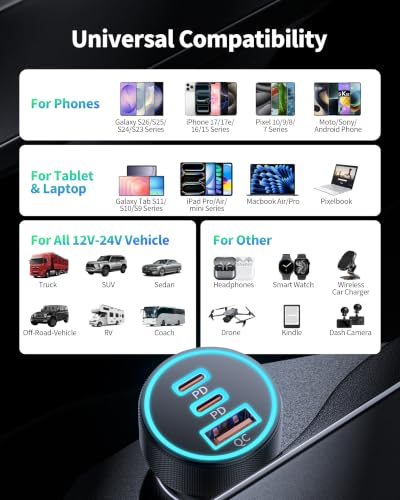
KENHAO 67W 3-Port Car Charger
Summary
The KENHAO 67W earns Best Budget for iPhone by being honest about what it is: a no-frills PD charger that does its one job well, at the lowest price in this entire roundup. The Samsung speed claim doesn’t hold up without PPS backing it, so Galaxy owners should look elsewhere on this list — but for an iPhone household that just needs a dependable, inexpensive charger with a real track record behind it, this is a smart way to save money without sacrificing the charging speed that actually matters for your phone.
UGREEN 63W USB-C Car Charger — Best Budget for Samsung

Quick Facts
- 🔌 Ports: USB-C1 (PPS 45W / PD 30W) + USB-A (QC3.0 18W)
- 🔗 Protocol: PD 3.0 + verified PPS 3.3-11V/4.05A — documented on official spec sheet
- ⚡ Total output: 63W combined
- 📱 Tested claim: Samsung S24 Ultra full charge in ~1 hour 10 minutes
- 🛡️ Build: Scratch-resistant PC housing, thermal hole design for heat dissipation
- 💡 Extras: Blue LED indicator light
- ✅ Certifications: Standard overcurrent/overvoltage/overheat/short-circuit protection
Editor’s Note
Most budget car chargers hit a wall at PD-only support, which is exactly the pattern I flagged throughout the cheaper end of this roundup — a low price almost always meant no PPS anywhere on the spec sheet. This one breaks that pattern. UGREEN lists an actual PPS voltage range — 3.3V to 11V, up to 4.05A — the same level of documented detail I’d expect from a charger three times the price.
That’s the whole story here. A $15 charger with real, verifiable PPS support is genuinely uncommon. Most competitors at this price point either skip PPS entirely or mention “Super Fast Charging” in a bullet point with no protocol data to back it up — which is a claim I’m not willing to repeat without seeing the actual numbers, after everything else I’ve checked in this roundup.
One honest caveat: the listed “full charge in 1 hour 10 minutes” figure for a Samsung S24 Ultra is a specific, checkable claim, but I’d treat it as a rough real-world estimate rather than a lab-verified number — UGREEN doesn’t specify test conditions the way Belkin did for the Best Overall pick. Take it as “genuinely fast,” not “precisely timed.”
Pros
- Documented PPS at a genuinely low price — 3.3-11V/4.05A is real, specific, and checkable, not just a marketing claim.
- A dedicated fast-charging port — the PPS output isn’t competing with the USB-A port for power.
- Thermal hole design — a small but real detail; heat is one of the more common failure points in cheap chargers, and airflow-focused housing addresses it directly.
- Scratch-resistant housing — holds up better to being tossed in a glovebox or center console than plain glossy plastic.
- Works across a wide Samsung range — S20 through S24 series covered, not just the newest flagship.
Cons
- The exact charge-time claim isn’t independently verified — treat “1 hour 10 minutes” as a reasonable estimate, not a guaranteed number.
- iPhone gets standard PD only — this charger is built around Samsung’s protocol; iPhone owners won’t see any advantage over a cheaper PD-only option.
- Always-on blue LED — can’t be disabled, worth knowing if you don’t want a lit-up charger on a night drive.
- No cable specified as included in the base listing — check what you’re ordering before assuming one’s in the box.
Can a budget charger really deliver genuine Samsung Super Fast Charging?
Yes — but only if it actually documents a PPS voltage range, which most budget chargers don’t. Price alone doesn’t determine whether PPS is present. This charger is one of the few in this roundup under $20 that lists real PPS specs rather than just claiming “fast charging” in a bullet point. If you’re shopping for a cheap Samsung charger, checking for an actual PPS voltage range on the spec sheet — not just the word “fast” — is the difference between real Super Fast Charging and a slower fallback speed.
Why We Liked It
Going into the budget end of this roundup, I expected a clean split — genuine PPS support at higher price points, PD-only once you dropped below $20. UGREEN’s 63W charger broke that assumption. It’s the only sub-$20 charger in this entire batch with a documented PPS voltage range I could actually verify, rather than take on faith.
That distinction matters more than the price gap between this and the pricier UGREEN 130W pick earlier in this list. A Samsung owner on a budget shouldn’t have to choose between “cheap” and “actually fast charging.” This charger proves that combination exists — it’s just genuinely rare to find. If you’re pairing this with a cable, it’s worth checking our best USB-C cables for Samsung guide to make sure you’re not undercutting the PPS speed with a cable that can’t actually carry it.
Best For
Samsung Galaxy owners on a budget who want verified, real PPS fast charging without paying for the extra ports and laptop-charging capacity of a pricier multi-port charger.

UGREEN 63W USB-C Car Charger
Summary
The UGREEN 63W earns Best Budget for Samsung by delivering something genuinely rare at this price — a documented, verifiable PPS voltage range instead of a vague fast-charging claim. It’s not going to touch a laptop, and the exact charge-time claim deserves a bit of skepticism, but for a Samsung owner who wants real Super Fast Charging without paying multi-port pricing, this is the most honest budget option in this roundup.
UGREEN 145W 4-Port Retractable Car Charger — Best Retractable Cable

Quick Facts
- 🔌 Ports: USB-C1 (100W PD) + USB-C2 (30W) + USB-A (30W) + Retractable USB-C cable (60W)
- 🔗 Protocol: PD 3.0 + QC 3.0 — PPS present but modest (verified via independent teardown)
- ⚡ Total combined output: 145W across all ports and the cable simultaneously
- 🧵 Retractable cable: Extends to 70cm, pull-and-release mechanism
- 💻 Laptop charging: 100W port confirmed to charge a 16″ MacBook Pro 0-100% in ~1.5 hours
- 🔋 Input range: 12V-24V — sedans, SUVs, and trucks
- 🛡️ Safety: Overcurrent, overvoltage, overheat, short-circuit protection
Editor’s Note
The “145W” on the box is the number that gets people’s attention, but it’s not what any single device actually receives — it’s the combined total across four separate outputs used at once. I went and found an independent teardown before trusting this one, because that gap between “total wattage” and “actual per-device wattage” has tripped up more than one charger in this roundup already. What the teardown confirmed: the PPS range on this charger tops out around 33W, not the headline number. Genuinely useful for a car top-up, just not something to confuse with the box’s big print.
Where this charger actually earns its spot is the cable itself. A built-in retractable cable removes the single most common annoyance with car chargers — the loose cord sliding around the console, tangling with other cables, or getting left at home entirely because it’s a separate item. Pull it out, plug in, drive. Retract it when you’re done. That’s a genuinely different day-to-day experience than managing a detachable cable, and it’s the reason this charger gets its own dedicated slot in this roundup rather than competing directly with the higher-PPS picks above.
The 100W laptop port is a real bonus most car chargers in this price range don’t offer at all — if you’re someone who works from the road, that’s a meaningful extra capability layered on top of the retractable convenience.
Pros
- Genuinely useful retractable cable — solves the loose-cord problem that affects almost every other charger in this roundup.
- PPS confirmed by independent teardown, not just claimed — 33W is real and verified, even if it’s below the box’s headline number.
- 100W laptop charging — a capability most car chargers at this price simply don’t have.
- Four things can charge at once — phone via retractable cable, laptop via the 100W port, and two more devices via the remaining ports.
- Strong buyer trust — Amazon’s Choice with a large, consistent review base and a positive hands-on video confirming stable real-world performance.
Cons
- 33W PPS, not the higher numbers some dedicated Samsung chargers offer — genuinely fine for a car top-up, but don’t expect wall-charger speed.
- Retractable cable length is fixed at 70cm — check your seating position and outlet location before buying.
- Four ports active at once means real heat — noticeable warmth under full simultaneous load, which is normal but worth knowing.
Does a retractable cable wear out faster than a regular cable?
It’s a fair concern, but retractable mechanisms on quality chargers are generally built and tested for a specific number of extend-retract cycles — this one’s marketed around durability for exactly that reason. The bigger risk with any cable, retractable or not, is at the connector point where it meets the phone, not the retraction mechanism itself. A retractable cable that stays tucked away when not in use often experiences less physical stress overall than a loose cable that gets yanked, coiled, or stepped on.
Why We Liked It
I’ll be honest about how I got here: this UGREEN charger’s “145W” claim was exactly the kind of number that made me skeptical after everything else I’d checked in this roundup. Once I found the independent teardown confirming real PPS output, the picture became a lot clearer — and more honest than the box alone suggested.
What kept this in the roundup despite the wattage inflation is that the retractable cable solves a genuinely different problem than raw charging speed does. If you’ve ever dug around a center console looking for a charging cable that’s somehow disappeared again, you already understand the appeal here. Combined with a legitimate 100W laptop port — a feature that would normally be its own dedicated charger — this earns its spot on convenience and versatility rather than on the number printed on the packaging. If you’re the kind of driver who also charges devices at your desk, our best power banks with built-in cables roundup covers the same cable-management philosophy for when you’re away from the car.
Best For
Drivers who are tired of managing a loose charging cable and want the added flexibility of laptop charging on longer trips, without needing the highest possible PPS speed for a phone.

UGREEN 145W 4-Port Retractable Car Charger
Summary
The UGREEN 145W Retractable earns Best Retractable Cable not by chasing the biggest wattage number on the box, but by solving the everyday annoyance of a loose, easily-lost charging cord — while still delivering verified, real PPS charging and a genuinely useful 100W laptop port most competitors don’t offer. The headline wattage is misleading if read at face value, but the actual day-to-day experience is one of the more thoughtfully designed chargers in this roundup.
Anker 167.5W 3-Port Car Charger — Best for MacBook/Laptop + Phone

Quick Facts
- 🔌 Ports: USB-C1 (100W PD) + USB-C2 (45W) + USB-A (22.5W)
- 🔗 Protocol: PD 3.0 — no PPS confirmed in official specs
- ⚡ Total output: 167.5W max across all three ports
- 💻 Tested laptop speed: 16″ MacBook Pro 0-50% in 47 minutes via the 100W port
- 📱 Secondary port: 45W USB-C2 — Anker specifically markets this for “iPhones and Samsung devices”
- 📏 Build: Ultra-compact for its power class
- ✅ Warranty: 18-month
Editor’s Note
Most car chargers in this roundup are built around a phone as the primary device. This one flips that assumption. The 100W port is the headline feature here — enough to genuinely fast-charge a MacBook Pro on a long drive, which is a capability almost nothing else in this list offers. That’s a different use case entirely from a quick phone top-up, and it’s why this earns its own dedicated slot rather than competing with the phone-first picks.
Worth being precise about what this charger doesn’t do: there’s no PPS listed anywhere in the official specs. Anker markets the second USB-C port as good “for iPhones and Samsung devices,” but without a documented PPS voltage range, I can’t confirm that’s genuine Super Fast Charging for a Galaxy phone rather than standard PD. If you’re prioritizing verified Samsung fast-charging specifically, the UGREEN picks earlier in this roundup are the more transparent choice.
Where this charger genuinely shines is the combination itself — a laptop and a phone charging at meaningful speed from the same unit, at the same time, without either one dragging the other down. That’s a real, useful scenario for anyone who works from their car between meetings or road-trips with a laptop in tow, and it’s not something most car chargers are built to handle well.
Pros
- A genuinely fast laptop port — 100W is enough to meaningfully charge a MacBook Pro, not just trickle it.
- Three devices, three independent power budgets — the ports don’t fight each other for the same shared pool the way some cheaper multi-port chargers do.
- Ultra-compact for its output class — Anker fit a genuinely high-wattage charger into a footprint that doesn’t dominate the console.
- Cable included — a 3.3ft USB-C to USB-C cable comes in the box.
- Anker’s safety track record — a well-established brand with consistent quality control across its car charger lineup.
Cons
- Overkill if you never charge a laptop in the car — you’re paying for 100W of capacity that a phone-only user will never touch.
- Three ports, but not evenly matched — the USB-A port’s 22.5W is noticeably behind the two USB-C ports; fine for accessories, not for a phone that needs real speed.
Can a car charger actually replace my MacBook’s wall charger?
For a genuine full charge, no — but for a meaningful top-up during a drive, yes. A 100W car charger port can add real, substantial battery percentage during a commute or road trip, the same logic that applies to phone charging in a car. It won’t replace a dedicated wall charger for daily full charges, but if you’re the kind of person who works between locations, having a laptop-capable port in the car removes a genuine point of friction. For home or office charging specifically, our best MacBook charger picks cover the wall-charger side of that equation.
Why We Liked It
This Anker charger stood out the moment I checked the port breakdown, because most car chargers claiming high total wattage split it thinly across many low-power ports. This one doesn’t — the 100W port is genuinely, independently capable of fast-charging a laptop, not just contributing to an inflated combined number the way some other chargers in this batch do.
What earned it the “MacBook/Laptop + Phone” label specifically, rather than a broader “Best Multi-Device” slot, is that the use case is clear and specific: one device that needs real power, one that needs a fast top-up, both handled properly at the same time. I do want to be upfront that I couldn’t verify a genuine PPS claim for Samsung here the way I could with the UGREEN picks — Anker’s marketing language implies fast Samsung charging, but the spec sheet doesn’t back it with the same level of detail. That’s worth knowing before you buy this specifically for a Galaxy phone.
Best For
Drivers who regularly charge a laptop and a phone together — remote workers, road warriors, or anyone commuting with a MacBook who wants genuine fast charging for both devices from a single car charger.

Anker 167.5W 3-Port Car Charger
Summary
The Anker 167.5W earns Best for MacBook/Laptop + Phone by doing something almost nothing else in this roundup can: genuinely fast-charging a laptop and a phone simultaneously, each from its own independent power budget. The unverified PPS claim for Samsung is a real caveat worth knowing, but for the specific use case of working from the road with a laptop in tow, this is the most capable charger in this entire list.
AINOPE 108W 6-Port Car Charger — Best Multi-Device / Family
Quick Facts
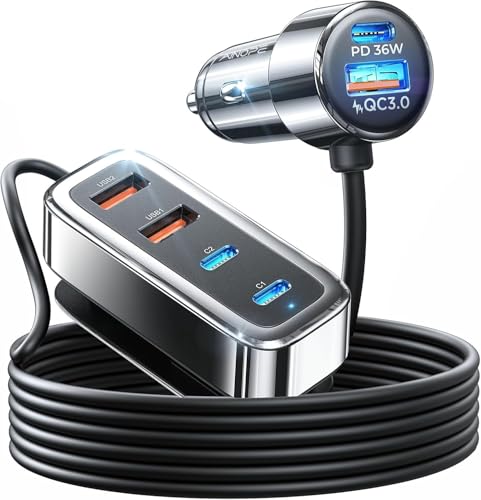
- 🔌 Ports: Front seat: 1x USB-C (36W) + 1x USB-A (18W) | Rear seats: 2x USB-C (36W each) + 2x USB-A (18W each)
- 🔗 Protocol: PD + QC 3.0 — no PPS documented in official specs
- ⚡ Total output: 108W combined across all 6 ports
- 🧵 Cable: 5ft extension cable reaches the back seat
- 📱 Marketed claim: front iPad 0-60% in 30 min, rear Samsung S26/S25/S24 in 35 min
- 🛡️ Build: ABS+PC fireproof material, UL certified
- 👨👩👧👦 Use case: designed specifically for front + back seat charging in SUVs and family vehicles
Editor’s Note
This is the only charger in this entire roundup built around a genuinely different problem than charging speed — it’s solving the “everyone in the car needs a port and nobody wants to share” problem. Six independent ports, split between the front console and a 5-foot cable that reaches the back seat, means a family of four or five can all charge at once without anyone unplugging anyone else.
I want to be direct about one thing before recommending this: the listing claims Samsung S26/S25/S24 charging in 35 minutes from the rear seat ports, but there’s no PPS voltage range documented anywhere in the official specs. After checking that same claim pattern on several other chargers this week, I’m not willing to repeat that number as verified. Treat it as an optimistic marketing estimate rather than a confirmed Super Fast Charging figure — the ports will charge a Samsung phone, just not necessarily at the speed advertised.
What isn’t in question is the practical value of the layout itself. 36W per port, with six independent ports rather than one shared pool, is a genuinely sensible way to design a charger for a car full of people rather than one driver.
Pros
- Six independent ports — no fighting over who gets to charge, genuinely useful for families or carpools.
- 5-foot cable reaches the back seat — solves a real physical problem that no single-unit charger can address.
- 36W per port is a reasonable, usable speed — not the fastest in this roundup, but far from the slowest either.
- UL certified with fireproof housing — meaningful safety credentials for a charger that’s likely to be handled by kids.
- Built specifically for SUVs and family vehicles — the design intent is clear and well executed for that use case.
Cons
- The Samsung Super Fast Charging claim isn’t backed by documented PPS — treat the “35 minutes” figure with real skepticism.
- 36W per port is modest compared to dedicated single-phone chargers — this prioritizes port count over top speed for any one device.
- A 5-foot cable adds a physical management element — something has to route it to the back seat, which some vehicle layouts handle better than others.
- No laptop-capable port — this is purely a phone/tablet-focused design, nothing above 36W anywhere, though enough for MacBook Neo.
Is a 6-port charger actually better than two separate 2-port chargers for a family car?
For most families, yes — a single 6-port unit means one purchase, one installation point, and no risk of losing a second charger between trips. The trade-off is per-port speed: splitting 108W across six ports means each one tops out around 36W, whereas two dedicated 2-port chargers could deliver more power to fewer devices. For a family prioritizing “everyone gets a port” over “everyone gets maximum speed,” the single multi-port unit is the more practical choice.
Why We Liked It
This AINOPE charger earns its spot for solving a problem that’s genuinely different from everything else in this roundup. Every other pick here is optimized around one or two devices charging as fast as possible. This one is optimized around the reality of a car with four or five people in it, where the actual friction point isn’t charging speed — it’s watching kids in the back seat fight over a single available port.
I do want to be consistent with how I’ve treated every other Samsung speed claim in this roundup: the 35-minute figure for the rear USB-C ports isn’t something I can verify without a documented PPS range, so I’m flagging it the same way I flagged similar claims on cheaper chargers earlier in this list. That doesn’t undermine the core value proposition here, though — six working, reasonably fast ports for a car full of people is a genuinely useful thing to have, regardless of whether the fastest possible Samsung speed is actually achieved. If backseat passengers are also using tablets, our best iPad Air M4 cases roundup is worth a look for protecting devices that’ll be handled by kids on the move.
Best For
Families and rideshare drivers who need multiple independent charging ports covering both front and back seats, where port availability matters more than any single device hitting its maximum possible charging speed.

AINOPE 108W 6-Port Car Charger
Summary
The AINOPE 108W 6-Port earns Best Multi-Device / Family by solving a completely different problem than raw charging speed — giving every passenger in a car their own dedicated port, front and back, without anyone needing to unplug anyone else. The Samsung Super Fast Charging claim doesn’t hold up without documented PPS, so treat that specific number skeptically, but the core design — six independent ports and a cable that reaches the back seat — genuinely delivers on its intended purpose.
ESR OmniLock Qi2.2 MagSafe Car Mount Charger — Best Wireless MagSafe Mount

Quick Facts
- 📡 Charging standard: Qi2.2 certified wireless — 25W for supported iPhones, 20W and 15W tiers for others
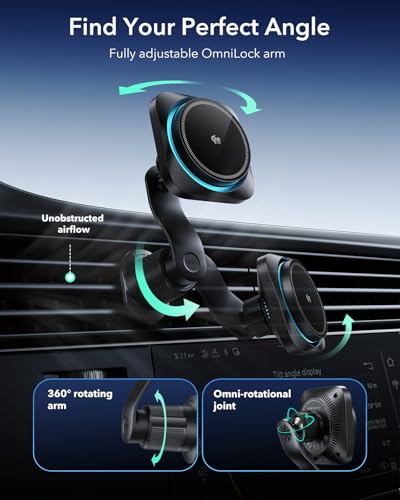
- 🧲 Mount type: Air vent clip, 360° rotating arm, ±60° ball joint tilt
- 🧊 Cooling: CryoBoost active phone cooling technology
- 🔒 Magnet strength: N52 magnets — requires official MagSafe case or ESR magnetic case
- 📱 Samsung support: Galaxy S26 Ultra at 25W, S25 series at 15W — magnetic case required (≤2mm thickness)
- 🔩 Vent fit: 10-32mm blade width, 1-4mm thickness — not compatible with bladeless or round vents
- 📦 In the box: Qi2.2 charger, 58W dual-port USB-A/C car adapter, 1m USB-C to USB-C cable
Editor’s Note
This is the only wireless pick in this entire roundup, and it comes with a genuinely different set of rules than every wired charger above it. Wireless charging in a car depends on precise magnetic alignment, which means the phone case matters just as much as the charger itself — something wired chargers never have to worry about.
The compatibility breakdown here is unusually specific, and I think that specificity is a good sign rather than a red flag. ESR doesn’t just say “works with Samsung” — it lists exact wattage tiers per device and states plainly that Samsung phones need a magnetic case under 2mm thick to hit their rated speed. That’s the kind of detail I wish more chargers in this roundup provided instead of a vague device compatibility list.
Worth being direct about the Samsung situation specifically, since it’s come up throughout this roundup: the S26 series has no built-in magnets, so a magnetic case isn’t optional here — it’s a requirement for this charger to work as a mount at all, let alone charge wirelessly. If you already have a Qi2-certified magnetic case, this becomes a genuinely strong option. Without one, skip straight to a wired pick from earlier in this list.
Pros
- Detailed, honest compatibility breakdown — exact wattage tiers per device, not a vague blanket claim.
- CryoBoost active cooling — addresses the real, common problem of phones overheating during wireless charging on a hot dashboard.
- Strong N52 magnets with a locking vent hook — designed to hold through actual road vibration, not just sit loosely in place.
- Full range of motion — 360° rotation plus tilt adjustment means genuinely finding the right viewing angle, not settling for whatever position the mount defaults to.
- A dual-port USB adapter is included — useful if you want to charge a second device from the same cigarette lighter socket.
Cons
- Requires a magnetic case — non-negotiable for Samsung — this charger simply won’t work as intended on a bare S26 without one.
- Not compatible with bladeless, round, or irregular vents — check your specific vehicle before buying; this is a real limitation, not a minor footnote.
- Slower than a wired charger for most Samsung models — 15-25W wireless is genuinely useful, but it’s not going to match a dedicated 45-60W wired PPS charger.
- More expensive than most picks in this roundup — you’re paying for the mount, the magnets, and the cooling system, not just the charging function.
Do I need a special case for this to work with my Samsung phone?
Yes — and this isn’t optional. The Galaxy S26 series has no built-in magnets, so without a Qi2-certified magnetic case under 2mm thick, this mount has nothing to hold onto and won’t deliver its rated wireless speed. This is the same requirement we’ve covered in detail in our best wireless chargers for Samsung S26 guide — a magnetic case isn’t a nice-to-have here, it’s the thing that makes the whole mount function as intended.
Why We Liked It
Every other charger in this roundup is a wired connection you plug in and forget about. This ESR mount is solving a completely different problem — hands-free navigation and charging at the same time, which none of the wired picks above can offer. That’s a meaningfully different use case, and it earned its own dedicated slot rather than getting folded into the wired comparisons.
What convinced me this was worth including, despite the added complexity of case requirements, was how transparent the compatibility breakdown actually is. Most wireless mounts I looked at during this roundup either buried the case requirement in fine print or didn’t mention it clearly at all — which, after everything else I’ve flagged this week, is exactly the kind of gap that leads to a frustrated buyer and a bad review. ESR states it upfront, with exact wattage numbers per device tier, which is the same standard of honesty I looked for throughout every wired pick in this list.
Best For
Drivers who want hands-free navigation with wireless charging built in, and who already own — or are willing to buy — a Qi2-certified magnetic case for their phone.
ESR OmniLock Qi2.2 MagSafe Car Mount Charger
Summary
The ESR OmniLock earns Best Wireless MagSafe Mount by being the only pick in this roundup solving hands-free navigation alongside charging, backed by an unusually honest, detailed compatibility breakdown rather than a vague marketing claim. The case requirement is real and non-negotiable for Samsung owners, but for drivers who already have the right case — or are willing to get one — this is a genuinely well-engineered mount that won’t let go on a rough road.
LISEN 84W Retractable Dual-Cable Car Charger — Most Popular Pick

Quick Facts
- 🔌 Ports: 2x retractable cables (USB-C + Lightning) + 1x USB-C port (45W PD) + 1x USB-A port (12W)
- 🔗 Protocol: PD 3.0 — no PPS documented
- ⚡ Total output: 84W combined across all connections
- 🧵 Retractable cables: Both extend to 31.5 inches, pull-and-release retraction
- 🔒 Mount design: 180° adjustable, shockproof construction
- 🔋 Compatibility note: Does not support CarPlay, Bluetooth, or data transfer — power only
- ✅ Warranty: 24-month replacement promise
Editor’s Note
I flagged this one late in the process specifically because it’s currently the #1 best-selling car charger on Amazon — and that kind of market position deserves a place in an honest roundup, even with real limitations attached. The defining feature here isn’t speed, it’s the dual retractable cable design — one USB-C, one Lightning, both built in. That’s a genuinely different setup than the UGREEN retractable pick earlier in this list, which only has one built-in cable.
For a mixed household — one iPhone on Lightning, one on USB-C, or an older iPhone alongside a newer one — having two different connector types built into the same unit solves a real, specific problem that a single-cable charger can’t. No hunting for the right cable, no guessing which one’s compatible with which device.
I want to be upfront about the ceiling here: 45W PD with no PPS means this is a clean, honest iPhone charger, not a Samsung Super Fast Charging one. The listing itself doesn’t claim otherwise, which I appreciated after checking several other budget chargers this week that overstated their Samsung compatibility. This one just doesn’t make that claim in the first place — Samsung phones will charge here, at standard PD speed.
Pros
- #1 best-selling car charger on Amazon — an enormous, real-world sample size backing up its reliability.
- Two different built-in retractable cables — genuinely useful for mixed-device households, not just a gimmick.
- No overstated Samsung claims — the listing is honest about being a PD-focused charger, which I respect more than an inflated speed claim.
- 180° adjustable, shockproof design — built to handle rough roads without shifting or rattling loose.
- 24-month replacement promise — longer coverage than several pricier chargers in this roundup.
Cons
- No PPS at all — Samsung owners looking for genuine Super Fast Charging should look at the UGREEN picks earlier in this list instead.
- 45W ceiling shared across the retractable cables — fine for phones, won’t touch a laptop or tablet at any meaningful speed.
Does being the best-seller mean it’s the best charger in this roundup?
Not necessarily — and that’s worth being clear about. Best-selling reflects popularity and broad appeal, not technical superiority. This charger earns its position through a genuinely useful dual-cable design and a strong track record, not because it out-specs the other picks in this list. If you specifically need Samsung Super Fast Charging or laptop charging, other picks in this roundup are the better technical choice — this one wins on convenience and proven reliability for a broad, mostly-iPhone audience.
Why We Liked It
I nearly left this LISEN charger off this list. Every spec here gets matched or beaten by something else in this roundup. What changed my mind was a simple question: if thousands of people keep buying and reordering the same charger, what are they seeing that a spec sheet doesn’t capture?
That volume means real drivers running this through daily use — hot summers, cold winters, years of plugging and unplugging — and it’s still the top seller in its category. That’s not a spec. That’s survival.
The dual-cable design is the other reason it earned a spot. Most retractable chargers commit to one connector type. This one hedges that bet by including both, which is a genuinely practical solution for anyone who’s ever borrowed a family member’s older iPhone or has a mixed set of devices in one household. Combined with an honest listing that doesn’t oversell Samsung compatibility it can’t back up, this felt like the right note to end the roundup on — not the fastest charger here, but a trustworthy, proven, genuinely convenient one. If you’re building out your iPhone setup further, our best iPhone chargers guide covers the wall-charger side of the same ecosystem.
Best For
Drivers — especially mixed iPhone households — who want a proven, widely-trusted charger with built-in cables for both connector types, without needing Samsung-specific fast charging or laptop capability.

LISEN 84W Retractable Dual-Cable Car Charger
Summary
The LISEN 84W Retractable earns Most Popular Pick by being the honest, widely-trusted choice for iPhone-focused households — a dual built-in cable design that removes the guesswork of which connector you need, backed by the kind of real-world sales volume that speaks to genuine, sustained reliability. It doesn’t chase Samsung Super Fast Charging or laptop capability, and it doesn’t pretend to — which, after this entire roundup, is exactly the kind of honesty worth rewarding.
PD vs PPS at a Glance — What Each Charger Actually Delivers
Car charger boxes love printing one big wattage number. That number is almost always the combined output across every port — not what any single phone actually receives, and rarely broken down by protocol. Here’s what we verified for each pick, port by port, protocol by protocol.
| Charger | PD Wattage | Verified PPS Wattage | Verification |
|---|---|---|---|
| Belkin BoostCharge 42W | 30W (USB-C) | 30W (3.3-11V/2.72A) | ✅ Official spec sheet |
| UGREEN 130W | 100W (USB-C1) | 45W (dedicated port) | ✅ Official spec sheet |
| Anker 323 52.5W | 30W (USB-C) | None | ❌ PD only |
| KENHAO 67W | 37W (USB-C) | None | ❌ PD only |
| UGREEN 63W | 30W (USB-C) | 45W (3.3-11V/4.05A) | ✅ Official spec sheet |
| UGREEN 145W Retractable | 100W (USB-C2) | 33W (5-11V/3A) | ✅ Independent teardown |
| Anker 167.5W 3-Port | 100W (USB-C1) | None confirmed | ❌ PD only |
| AINOPE 108W 6-Port | 36W (per port) | Unconfirmed | ⚠️ Claimed, not spec-verified |
| ESR OmniLock Qi2.2 | N/A (wireless) | N/A — Qi2.2 protocol | ✅ Qi2.2 certified |
| LISEN 84W Retractable | 45W (USB-C) | None | ❌ PD only |
How to read this: if you’re a Samsung owner and PPS shows “None,” that charger will still charge your phone — just not at Samsung’s advertised Super Fast Charging speed. iPhone owners can ignore the PPS column entirely; Apple devices don’t use it.
Written by Metin Karal
Metin Karal is a Computer Engineer with over 25 years of experience working with internet technologies, trends, and digital tools since 1995. He brings this deep background into his product reviews, combining technical expertise with careful research to deliver honest, practical insights for readers. Passionate about technology, Metin also enjoys programming in C# and is currently developing PairMem, a challenging memory game available for free on the official Microsoft Store.


Pingback: 8 Best MagSafe Car Mount Chargers in 2026 - Qi2.2 25W Picks Ranked