Written by Metin KARAL – Computer Engineer with 25+ years of experience in internet technologies. Some products here are tested directly, while others are evaluated through detailed research, specifications, and verified customer feedback. This article may contain affiliate links; as an Amazon Associate we earn from qualifying purchases at no extra cost to you.
Every camera in this roundup is solar-powered and wire-free — no electrician, no power outlet, no battery swaps. What separates these eight picks from the hundreds of generic solar cameras on Amazon is that each solves a specific problem: the one that actually matters to the buyer reading this page.
Solar outdoor cameras have improved dramatically in recent years. Active solar panels now sustain cameras on as little as 45 minutes of direct sunlight per day. AI detection that previously required a monthly subscription now ships free on most models. And the gap between budget-tier image quality and premium has narrowed to the point where a $47 camera can capture faces and licence plates in full colour at night. What hasn’t changed: choosing the wrong camera for your specific installation still means poor performance regardless of price. A camera with an 8m night vision range is the wrong pick for a large driveway. A camera with a 1.6W solar panel is the wrong pick for a north-facing wall. A camera with on-device-only storage is the wrong pick for a high-theft location.
Best Outdoor Solar Security Camera under $100
| Camera | Why It’s Here |
|---|---|
| Tapo C615F Solar Floodlight | The only pick combining an 800-lumen floodlight, 360° AI auto-tracking, and 45-minute solar top-up in one wire-free kit — free person/pet/vehicle detection included; Tom’s Guide and PCWorld both recommended it for buyers who want a self-sufficient system without ongoing subscription costs. |
| eufy SoloCam S220 | IP67 weatherproofing and f/1.6 aperture — the strongest weather rating and widest lens aperture in this roundup; 8GB built-in storage means all core features including AI human detection work free from day one with zero subscription, ever. |
| Reolink Argus Eco | 512GB microSD support with zero cloud requirement — all footage stays on your own hardware by default; free human/vehicle/pet detection across three simultaneous alert channels; the pick for buyers who want every frame to remain private and local. |
| Tapo C402 Solar Camera | Consumer Reports lab tested and PCWorld reviewed — the only budget pick with that editorial combination; free person detection, 30fps recording, full-colour spotlight night vision, and 45-minute solar top-up from a brand with global support infrastructure. |
| ARCCTV 2-Pack | The only dual-band 2.4GHz + 5GHz solar camera in this roundup — auto-selects the best band for lag-free live streaming in congested wireless environments; 4MP resolution and 99ft PIR detection range across two complete solar setups. |
| Hiseeu C90 2-Pack | Best per-camera value in this roundup — named all-rounder by Renewables Today; two complete 4MP solar setups with full-colour dual-mode night vision, IP66 weatherproofing, and three-mode siren alarm at the lowest per-camera price here. |
| SEHMUA 2K 2-Pack | 98ft night vision range — the longest in this roundup — nearly double the closest competitor; dual-antenna Wi-Fi for stronger signal at perimeter distances; 6,000mAh battery field-tested through hurricane conditions by ACFC. |
| AOSU Solar Camera | The only pick with automatic human tracking under $85 — camera pans and tilts to follow detected subjects across 360° without manual app intervention; lifetime technical support with local phone service backs the hardware indefinitely. |
Tapo C615F Solar Floodlight Camera — Best Overall Pick

Quick Facts
- 📷 Resolution: 2K 3MP (2304×1296px) — 15/20fps; F1.6 aperture; 1/2.8″ CMOS sensor
- 🔍 Field of View: 100.6° diagonal; 10.8× digital zoom
- 🔄 Pan/Tilt: 338° pan mechanical (360° coverage); 97° tilt (141° tilt coverage)
- 🤖 AI Tracking: 360° automatic tracking — person, pet, vehicle
- 🚨 Detection: Person / Pet / Vehicle — free, no subscription required; activity zones included
- 💡 Floodlight: 800-lumen dimmable LED — motion-activated or manual; adjustable angle
- 🌙 Night Vision: 2× 850nm IR LEDs; 32.8ft / 10m range; full-color with floodlight active
- ☀️ Solar: 2.5W panel (Tapo A201 included) — 45 minutes direct sunlight = full day operation
- 🔋 Battery: 10,400mAh built-in lithium-ion — up to 140 days without sunlight
- 📡 Wi-Fi: 2.4GHz IEEE 802.11b/g/n; PCWorld confirms dual-band 2.4/5GHz adapter onboard
- 🔊 Siren: 91.5 dBA at 10cm; 75 dBA at 3 metres; customisable audio recording
- 💾 Storage: microSD up to 512GB (not included); Tapo Care cloud (30-day free trial)
- 🌡️ Weather: IP65; operating temperature -20°C to 45°C (-4°F to 113°F)
- 📦 Included: Camera, A201 solar panel + bracket, USB cable, 3.8m solar extension cable, mounting kit
- 🔗 Smart home: Amazon Alexa, Google Home
- 🛡️ Warranty: TP-Link standard warranty
Editor’s Note
Tom’s Guide described the Tapo C615F Kit as an excellent option for buyers looking for a self-sufficient security camera with advanced features and the option to avoid ongoing subscription costs — particularly for those in the Google or Alexa ecosystems. The editorial position is earned by one combination that no other pick in this roundup replicates: a 2K pan/tilt camera, an 800-lumen dimmable floodlight, 360° AI auto-tracking, and solar charging in a single wire-free kit. Every other camera here is either a static bullet camera or a PTZ dome without a floodlight. The C615F is the only pick that actively lights up the area it’s monitoring — turning night-time 2K footage from infrared greyscale into full-colour video without any artificial light source beyond the unit itself.
HomeCamCafe’s reviewer, who installed the C615F on their own house, described it as a product that genuinely solves a specific problem — how to get a floodlight camera with pan/tilt coverage somewhere without power — and confirmed it has been running without any intervention since installation. The 45-minute solar top-up for full-day operation is the practical headline: most competing solar cameras need 2–3 hours of direct sunlight. The 10,400mAh backup battery covers up to 140 days without any sun at all — the deepest safety net in this roundup. PCWorld’s hands-on confirmed the 10,400mAh battery, dual-band Wi-Fi, two-way audio with noise cancellation, and a 97 dB siren — noting person, pet, and vehicle detection all work free without any subscription, with Tapo Care adding cloud snapshot notifications on top for buyers who want them. The honest limitation: the C615F sits at the higher end of this roundup’s price range, and AI detection via snapshots in push notifications requires Tapo Care — free local detection works, but you won’t see a clip of what triggered the alert without the subscription. For buyers who want zero subscription involvement, the microSD card handles all recording locally without compromise.
Pros
- Tom’s Guide and PCWorld independently reviewed and recommended — hands-on editorial validation from two major tech publications
- Only floodlight + PTZ + solar + AI tracking combo in this roundup — 800-lumen dimmable light, 360° auto-tracking, and 2K video in one wire-free unit
- 45 minutes of sunlight = full-day operation — the most efficient solar charging spec in this roundup; 10,400mAh battery backs up to 140 days without sun
- Person/pet/vehicle detection free — no subscription needed for AI detection or activity zones; significantly more generous than Ring or Nest
- Patrol mode — assign preset positions for the camera to cycle through automatically; no other pick in this roundup has this feature
- Customisable sound and light alarm — record your own audio for the siren; adjust floodlight brightness for alarm scenarios
- 512GB microSD support — the highest SD card capacity in the roundup; up to a year of motion-triggered 2K footage without overwriting
- -20°C (-4°F) operating temperature — the coldest-weather rating in this roundup; reliable in northern climates where other cameras struggle
- 91.5 dBA siren — the loudest alarm in this roundup at close range
Cons
- 2.4GHz primary spec — datasheet lists 2.4GHz; PCWorld confirms a dual-band adapter but this should be verified at setup for 5GHz-dependent households
- 15/20fps only — lower frame rate than 30fps competitors; video is smooth for surveillance but not broadcast quality
- Larger and heavier than dome cameras — 682g camera unit; more visible installation; not suitable for discreet placement
- Solar extension cable is 3.8m — panel and camera can be separated up to 3.8m; installations requiring greater separation need a third-party cable
Why We Liked It
The Tapo C615F is the pick that makes every other solar camera in this roundup look like it’s solving half the problem. The combination of solar power, 800-lumen floodlight, 360° pan/tilt with AI tracking, and free person/pet/vehicle detection puts advanced features into a single outdoor-ready unit without a tangle of wires — and the AI motion filtering means alerts arrive for real events rather than every leaf that moves. The floodlight is the differentiator that compounds everything else: when the C615F detects motion at night, it floods the area with 800 lumens of dimmable light, the 2K camera captures full-colour footage of whatever triggered the alert, and the 360° AI tracking follows the subject across the frame automatically. That sequence — light, colour video, tracking — happens without any manual intervention and without any subscription. HomeCamCafe’s reviewer called it one of those products that genuinely solves a problem — running maintenance-free since installation — and noted the solar efficiency means even a relatively shaded installation stays charged without manual intervention. The Patrol Mode adds a layer no other pick here offers: the camera cycles through preset positions on a schedule, providing active dynamic monitoring rather than waiting passively for motion. Tom’s Guide concluded it is an excellent option for buyers who want a self-sufficient system and don’t want to pay ongoing subscription costs — and for a roundup built around the premise of solar cameras with no mandatory fees, that editorial verdict is the right one to anchor the Best Overall position.
Cloud Support
The Tapo C615F stores all motion-triggered footage locally to a microSD card (up to 512GB, not included) with zero subscription required — live streaming, AI person/pet/vehicle detection, activity zones, and local recording all work completely free out of the box. Tapo Care is the optional cloud layer that adds video history stored off-site and richer push notifications — and unlike Ring or Nest, which require a paid plan to unlock AI detection at all, everything Tapo offers for free is already more than most competing brands provide behind a paywall.
What Tapo Care specifically adds for the C615F: push notifications with a video clip or snapshot of the triggering event (free alerts show only that motion occurred, not what caused it), 30 days of rolling cloud video history accessible from anywhere, and smart playback with event filtering in the app. A 30-day free trial activates automatically when the camera is set up — enough time to decide whether cloud clip notifications are worth the ongoing cost for your specific installation.
For most buyers, the 256GB (or 512GB better) microSD card is the practical answer: at motion-trigger rates for a typical household, it covers months of 2K footage before any overwriting occurs, costs a one-time fee of under $15, and keeps all footage private on your own hardware. Cloud storage makes the most sense for high-theft-risk locations — a driveway or front gate where the camera itself could be stolen — since footage stored in the cloud survives even if the hardware doesn’t.

Tapo C615F Solar Floodlight Camera
Best For: Homeowners who want the most capable single solar security unit available — floodlight, 360° AI tracking, free smart detection, and 45-minute solar top-up in one wire-free kit that works in temperatures down to -20°C without a subscription.
Summary
The Tapo C615F is the Best Overall pick — the only solar camera in this roundup combining an 800-lumen dimmable floodlight, 360° AI pan/tilt tracking, free person/pet/vehicle detection, and 45-minute solar top-up in a single wire-free kit reviewed by both Tom’s Guide and PCWorld. Lower frame rate and subscription-gated clip notifications are the honest trade-offs. For homeowners who want a solar camera that actively lights, tracks, and records in full colour without monthly fees — this is the one.
eufy SoloCam S220 — Best No-Subscription Pick

Quick Facts
- 📷 Resolution: 2K (2304×1296px); f/1.6 aperture; 1/2.8″ CMOS sensor; 15fps
- 🔍 Field of View: 135° — fixed bullet camera; no pan/tilt
- 🌙 Night Vision: 4× IR LEDs; f/1.6 aperture for low-light performance; Night Color technology
- ☀️ Solar: Integrated solar panel — 3 hours direct sunlight per day for continuous operation
- 🔋 Battery: 6,500mAh built-in lithium-ion rechargeable
- 🤖 Detection: AI human detection — free, no subscription; motion alerts included
- 💾 Storage: 8GB built-in eMMC — no microSD slot; expandable via HomeBase 3 (sold separately)
- 🌡️ Weather: IP67 — the strongest weatherproofing rating in this roundup
- 📐 Dimensions: 3.17″ × 3.82″ × 2.26″; 11.04 oz — compact single-drill-hole installation
- 📡 Wi-Fi: 2.4GHz only
- 🔗 Smart home: Amazon Alexa, Google Assistant; HomeBase 3 compatible (face recognition unlock)
- 🛡️ Warranty: eufy standard warranty; Anker parent company
- ⚠️ Note: No microSD slot — storage is 8GB built-in or HomeBase 3 only; no cloud storage free tier
Editor’s Note
Trusted Reviews described the eufy SoloCam S220 as something of a bargain — a wireless security camera with no ongoing costs, human detection, a built-in solar panel, and 2K video that most wireless security cameras charge significantly more for and deliver fewer features. The editorial case rests on eufy’s foundational design principle: everything the S220 needs to function as a complete outdoor security camera is built into the unit itself, and none of it requires a monthly payment. Human detection, motion alerts, live streaming, and local recording are all operational from day one without creating an account subscription or entering payment details. That stands in direct contrast to Ring and Nest, which gate AI detection and video history behind paid plans.
T3’s hands-on review awarded full marks to the eufy app for how quickly and efficiently setup works — up and running in just a few minutes — and confirmed the S220 tested without issues across every department from ease of installation to video quality and audio clarity. The f/1.6 aperture is the optical specification that matters most for outdoor night vision: it allows significantly more light into the sensor than the f/2.0 or f/2.4 lenses common at this price tier, producing cleaner infrared footage at the edges of the detection range. Gadget Geek Boy’s real-world review confirmed this in practice — after dark, the f/1.6 lens and IR deliver clean monochrome footage with good face clarity at typical front-door and driveway distances.
The IP67 weatherproofing is the strongest rating in this roundup — one step above the IP65 of the Tapo C615F and IP66 of most competitors. IP67 means the S220 is rated for temporary submersion, not just rain and splash. For buyers in heavy rainfall climates or coastal environments, that difference is meaningful long-term. The honest trade-offs are equally important to state clearly: the S220 has no microSD card slot — all local storage is the built-in 8GB, which covers months of motion-triggered events but cannot be expanded without adding a HomeBase 3 hub. Home Security Camera Guru’s extended review noted the app interface feels somewhat clunky compared to competitors, motion detection can be fooled by shadows, and the most significant risk of the on-device storage model is that a stolen camera takes its evidence with it — cloud backup is the only solution to that problem, and it requires a paid subscription. The eufy app ad injection reported in early 2025 is also worth noting: some users encountered promotional screens within the app after an update, though eufy responded to user complaints.
Pros
- T3 and Trusted Reviews independently reviewed and recommended — hands-on editorial validation; T3 awarded full marks for app setup speed and overall performance
- IP67 weatherproofing — the strongest weather rating in this roundup; rated for temporary submersion; outlasts IP65 and IP66 alternatives in sustained rain and coastal exposure
- f/1.6 aperture — the widest lens aperture in this roundup; more light on sensor means cleaner night vision without artificial illumination
- 8GB built-in storage — zero subscription for full functionality — human detection, motion alerts, live streaming, and local recording all free from day one
- Integrated solar panel — no separate panel or bracket needed; 3 hours of daily sunlight sustains continuous operation; compact single-unit form factor
- HomeBase 3 compatible — optional upgrade path to facial recognition, expandable local storage up to 16TB, and multi-camera management without cloud fees
- AI human detection free — filters pets, cars, and environmental motion; only alerts on people; no paid tier required
- 6,500mAh battery — larger battery than most competing bullet solar cameras; sustained operation through extended overcast periods
- Single drill-hole installation — compact dimensions; faster to mount and reposition than larger camera units
Cons
- No microSD card slot — 8GB built-in only; cannot expand local storage without purchasing HomeBase 3 separately; if the camera is stolen, footage goes with it
- No pan/tilt — fixed 135° field of view; covers one angle only; no tracking; buyers who need wider coverage need multiple units
- 3 hours sunlight required — less efficient than Tapo C615F’s 45-minute top-up; north-facing or heavily shaded installations may struggle in winter
- 2.4GHz only — no 5GHz support; performance depends on 2.4GHz signal strength at the installation point
- No floodlight — infrared night vision only; no illumination of the monitored area; colour night vision requires external light source
Why We Liked It
The eufy SoloCam S220 earns the no-subscription pick position for the same reason Trusted Reviews called it a bargain: it delivers more useful security camera features for free than most competitors charge for. Home Security Camera Guru’s extended review summarised the core appeal directly — the S220 is for buyers fed up with cloud subscriptions and climbing a ladder every few months to swap batteries; it checks all the boxes for a single-camera setup watching a front door, driveway, or backyard and does the job without much babysitting once motion settings are tuned. The IP67 rating is the specification that compounds long-term value: most competing cameras at this tier are IP65, and the difference in weatherproofing adds real-world durability for buyers who install in exposed locations and don’t want to worry about the camera failing in the second winter. Six months of field testing by Batten Home Security found the solar charging to be the game-changer — even in partial shade the camera maintained power without intervention — and concluded the S220’s combination of solar power and reliable core features matters more in daily use than marginal resolution or AI feature upgrades. The HomeBase 3 upgrade path is worth understanding before buying: the S220 works as a standalone camera indefinitely, but adding HomeBase 3 later unlocks facial recognition, significantly expanded local storage, and multi-camera management — a scalable architecture that lets buyers start simple and grow. For buyers who want a solar security camera that works completely, permanently, and privately without ever asking for a credit card — this is the pick.
Cloud Support
The eufy SoloCam S220 is the most subscription-resistant camera in this roundup — by deliberate design. All core functionality is free: human detection, motion alerts, live streaming, and local recording to the built-in 8GB all work without an account subscription or payment details. eufy is the only brand in this roundup that offers local storage robust enough to replace cloud storage entirely for most users — the 8GB built-in covers months of motion-triggered events at typical household activity levels before any overwriting occurs.
Cloud backup is available but entirely optional, at approximately $2.99–$3.99 per camera per month for 30 days of rolling video history stored off-site. Cloud backup makes the most sense specifically for outdoor cameras in high-theft-risk locations — where losing the hardware could also mean losing critical footage, since the S220’s on-device storage goes with the camera if it’s stolen. That is the one scenario where paying for eufy’s cloud plan is genuinely justified rather than optional.
The HomeBase 3 alternative is worth knowing: adding a HomeBase 3 hub (sold separately) connects the S220 to a local storage system expandable up to 16TB — providing months or years of footage retention at a one-time hardware cost, with no recurring fees. For buyers who want off-site insurance without a monthly subscription, a HomeBase 3 with an attached SSD is the most cost-effective long-term answer. For buyers who want the simplest possible setup with no additional hardware — the 8GB built-in, tuned to motion-trigger-only recording, handles daily security needs without cloud involvement.

eufy SoloCam S220
Best For: Homeowners who want a fully capable 2K solar security camera with AI human detection, IP67 weatherproofing, and zero subscription fees — the pick for privacy-focused buyers who want on-device storage and the option to expand into the eufy ecosystem later without cloud commitment.
Summary
The eufy SoloCam S220 is the no-subscription pick — 2K video, f/1.6 aperture, IP67 weatherproofing, AI human detection, and integrated solar charging in a compact single-unit design reviewed by T3 and Trusted Reviews, with all core features free from day one and a HomeBase 3 upgrade path for buyers who want to expand. No microSD slot, fixed viewing angle, and eufy app quality concerns are the honest trade-offs. For buyers who want a solar security camera that works completely and privately without a monthly fee — this is the one.
Reolink Argus Eco — Best Privacy-First Pick
Quick Facts
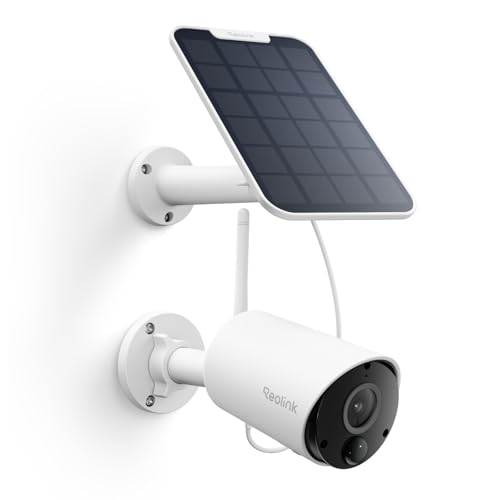
- 📷 Resolution: 2K 5MP (2304×1296px); 15fps; MPEG-4; CMOS sensor
- 🔍 Field of View: 110° diagonal; 100° horizontal; fixed bullet — no pan/tilt
- 🌙 Night Vision: 6× infrared LEDs; 33ft / 10m range; black-and-white IR; no colour night vision
- ☀️ Solar: 3W panel (included) — separate mountable panel; up to 13ft cable separation from camera
- 🔋 Battery: 18.72Wh lithium-ion built-in; non-removable — solar or USB-C charging only
- 🤖 Detection: Human, vehicle, and pet detection — free, no subscription; push notification + email + siren alert options
- 💾 Storage: microSD up to 512GB (not included); no built-in storage; Reolink cloud optional
- 📡 Wi-Fi: 2.4GHz only
- 🌡️ Weather: IP65; operating temp 14°F to 131°F (–10°C to 55°C)
- 🔍 Zoom: 10× digital; autofocus
- 🔊 Alerts: Push notification, email, and siren — three alert channels simultaneously
- 🔗 Smart home: Amazon Alexa, Google Assistant, Reolink Home Hub compatible
- 📐 Dimensions: 8.53″ × 6.25″ × 6.21″; 1.32 lbs — larger bullet form factor
- 🛡️ Warranty: Reolink standard warranty
- ⚠️ Note: Battery is non-removable; solar panel mounts separately from camera body
Editor’s Note
The Reolink Argus Eco has the most extensive real-world validation of any pick here. SafeHome.org’s hands-on review confirmed 4–5 minute DIY installation from unboxing to live feed, with QR code pairing completing in minutes and a mounting plate with clear instructions making the physical install genuinely fast. TechHive’s reviewer described the Argus Eco as a joy to use — setup free of the complexities that hang up many other camera installations, with the Reolink app letting buyers get the most out of the camera’s features without excessive configuration. For buyers who’ve read our indoor security camera guide and are now extending coverage outdoors, the Reolink app will feel immediately familiar — Reolink uses the same interface across their entire lineup.
The privacy-first position is earned by the storage architecture: all footage records locally to a microSD card of your choice, up to 512GB — the joint-largest SD card support in this roundup alongside the Tapo C615F. No footage leaves the camera unless you choose to upload it. No cloud account is required, no footage is processed on remote servers, and the camera functions completely without internet access for local SD recording. Human, vehicle, and pet detection all work free with no subscription, and alerts arrive via push notification, email, and siren simultaneously — three notification channels that no other pick in this roundup offers together at no cost.
The honest limitations are equally important to state. The 3W solar panel is a separate unit that mounts independently from the camera body — useful for optimising sun exposure but requiring two mounting points rather than one. Colour night vision is not available — the Argus Eco uses infrared LEDs only, producing black-and-white footage after dark. Buyers who want colour night vision need the floodlight-equipped C615F or a camera with an integrated spotlight. The non-removable battery means the camera cannot be taken down for indoor charging — it must be charged in place via USB-C or kept topped up by the solar panel. SafeHome.org noted an important practical workaround for the solar charging indicator bug: the panel can incorrectly report “full” when the battery is low, and the recommended solution is to charge the camera to at least 60% via USB-C before first outdoor installation to establish a reliable baseline. The 14°F (-10°C) minimum operating temperature is the warmest lower limit in this roundup — buyers in very cold northern climates should note this against the Tapo C615F’s -4°F (-20°C) rating.
Pros
- 9,352 Amazon reviews — the largest real-world validation pool in this roundup; sustained buyer confidence across multiple years of outdoor deployment
- SafeHome.org and TechHive independently reviewed — hands-on editorial coverage from two established security publications
- 512GB microSD support — the joint-highest SD card capacity in this roundup; a year or more of motion-triggered footage without overwriting at typical household activity levels
- Complete local storage privacy — all footage stays on your SD card; no cloud account required; no remote processing; camera operates fully offline for recording
- Free human/vehicle/pet detection — three detection categories with no subscription; push notification + email + siren simultaneously
- Separate solar panel — panel mounts independently from camera; optimal sun exposure without compromising camera placement angle
- 10× digital zoom with autofocus — the sharpest close-detail capability in the budget solar camera tier; useful for licence plates and face identification at driveway distances
- Reolink Home Hub compatible — optional local NAS-style storage expansion without cloud fees; scalable ecosystem
- 4–5 minute DIY installation — SafeHome.org confirmed fastest installation in their testing batch
Cons
- Black-and-white IR night vision only — no colour night vision, no spotlight, no floodlight; after-dark footage is monochrome infrared only
- Fixed 110° bullet camera — no pan/tilt, no tracking; covers one angle; buyers needing wider coverage need multiple units or a PTZ alternative
- Non-removable battery — camera must be charged in place via USB-C or solar; cannot be unmounted for indoor charging
- 14°F (-10°C) minimum operating temperature — the warmest lower limit in this roundup; not suitable for very cold climates where the Tapo C615F’s -4°F rating is needed
- Two mounting points required — camera and solar panel mount separately; more installation planning needed than single-unit designs
Why We Liked It
The Reolink Argus Eco earns the privacy-first position because it is the camera in this roundup where your footage is most completely under your own control. All recording goes to your own SD card, nothing leaves the device without your action, and the camera functions for recording purposes without any internet connection whatsoever. TechHive’s reviewer noted the Reolink app lets buyers get the most out of the Eco’s features without a lot of configuration — and strongly recommended pairing with the solar panel, which is included in this kit, for buyers who don’t want to unscrew the camera from its mount every few months to charge the battery. SafeHome.org’s 2026 review confirmed the 4–5 minute installation as genuinely fast — the mount attaches via a single screw, the QR code pairing completes quickly, and the camera is live within minutes of opening the box. The 512GB SD card support changes the storage mathematics entirely: at motion-trigger rates for a typical residential property, a 512GB card covers well over a year of footage before any overwriting occurs, making the Reolink the closest thing to a set-and-forget security camera in this roundup. The 10× digital zoom with autofocus is the detail that makes this camera specifically valuable for licence plate and face identification at driveway or entry-point distances — capabilities that matter when reviewing footage after an incident rather than during live monitoring. For buyers who want every frame of footage to remain private, local, and under their own control — this is the pick that takes that requirement most seriously.
Cloud Support
The Reolink Argus Eco is built around local storage as the primary — and default — option. All motion-triggered footage records directly to a microSD card (up to 512GB, not included) with no cloud account, no subscription, and no internet connection required for recording. Every detection category — human, vehicle, pet — triggers local recording and sends alerts without any ongoing fees. This is the most complete offline-capable setup in this roundup.
Reolink’s optional cloud service is available for buyers who want off-site backup, storing motion-triggered clips remotely for access if the camera is stolen or damaged. Unlike eufy’s cloud tier, Reolink’s cloud plan is rarely the primary recommendation — the 512GB SD card support makes local storage so comprehensive that most buyers never need off-site backup. At typical household motion-trigger rates, a 256GB card covers several months of 2K footage; a 512GB card covers a year or more — making the one-time SD card purchase a far more cost-effective answer than a recurring cloud subscription for most use cases.
For buyers who want an additional layer of local redundancy without cloud fees, the Reolink Home Hub connects multiple Reolink cameras to a local NAS-style storage system — providing centralised footage management, expanded capacity, and off-camera storage that survives even if an individual unit is stolen, all at a one-time hardware cost with no monthly fees.

Reolink Argus Eco
Best For: Privacy-focused homeowners who want all footage stored locally on their own 512GB SD card with no cloud requirement, free human/vehicle/pet detection across three alert channels, and independently reviewed 4–5 minute DIY installation — the pick for buyers who want outdoor solar coverage without sending a single frame of footage to a remote server.
Summary
The Reolink Argus Eco is the privacy-first pick — 2K 5MP resolution, 512GB microSD support, free human/vehicle/pet detection with three simultaneous alert channels, and 9,352 Amazon reviews backing years of real-world outdoor deployment, with all footage staying on your own SD card by default. Black-and-white IR night vision only, fixed bullet angle, and a solar charging indicator bug to work around on first install are the honest trade-offs. For buyers who want outdoor solar coverage where every frame stays on their own hardware — this is the pick.
Tapo C402 Solar Camera — Best Budget Brand-Name Pick

Quick Facts
- 📷 Resolution: 1080p Full HD (1920×1080px); 30fps; MPEG-4
- 🔍 Field of View: 125° — fixed bullet camera; no pan/tilt
- 🌙 Night Vision: Built-in spotlight; full-colour night vision up to 30ft — colour, not infrared
- ☀️ Solar: 5W monocrystalline silicon A201 panel (included) — 45 minutes direct sunlight = full day; 13ft separation cable included
- 🔋 Battery: 5,200mAh lithium-ion (2 cells) — up to 180 days without sunlight
- 🤖 Detection: Person and motion detection — free, no subscription; activity zones included
- 💾 Storage: microSD up to 512GB (not included); Tapo Care cloud optional (30-day free trial)
- 📡 Wi-Fi: 2.4GHz — long-range optimised
- 🌡️ Weather: IP65; operating temp -4°F to 113°F (-20°C to 45°C)
- 🔊 Audio: Two-way audio; built-in microphone and speaker
- 🔐 Privacy: Encrypted video; two-factor authentication; password-protected SD card
- 🔗 Smart home: Amazon Alexa, Google Assistant; shared account multi-user access
- 📦 Included: Camera, A201 solar panel + bracket, USB adapter, extension wire, full mounting kit
- 🛡️ Warranty: TP-Link standard warranty
- ⚠️ Note: 1080p only — a 2K version exists at a higher price point; if resolution is the priority, that is the upgrade path
Editor’s Note
Consumer Reports included the Tapo C402 in their home security camera test programme, rating it across video quality, data security, and nighttime performance — making it one of only two cameras in this roundup with Consumer Reports lab validation alongside PCWorld’s independent hands-on review. For buyers navigating the solar outdoor camera market for the first time, our How to Choose a Security Camera guide breaks down exactly what specifications matter for outdoor solar use — and the C402 hits the practical minimum threshold on every one of them at the lowest brand-name price in this roundup.
PCWorld’s reviewer described the C402 as an affordable and eco-friendly security solution that’s perfect for low-maintenance outdoor monitoring, confirming that daytime footage was crisp and detailed, capturing clear images of faces, vehicle plates, and other key details despite the 1080p resolution. Review-rating.com’s assessment noted the C402 is particularly well-suited for renters or anyone who cannot run cables through walls — including detached garages, backyard sheds, or cabins that rarely see a service visit — a positioning that reflects the C402’s genuine strength: it installs anywhere, runs indefinitely on solar, and asks for nothing after setup. The monocrystalline silicon solar panel is a specification detail worth highlighting — monocrystalline cells are more efficient per square inch than the polycrystalline panels used in most budget solar cameras, which is why the C402 achieves the same 45-minute top-up figure as the more expensive C615F despite a comparable panel size.
The honest limitations are important for informed buying. 1080p is the primary trade-off — every other camera in this roundup except the Hiseeu shoots 2K or higher, and the resolution difference is perceptible when zooming into faces or licence plates at distances beyond 5–6 metres. PCWorld’s reviewer noted that 1080p footage holds up well for most home monitoring needs but buyers for whom pixel-perfect detail is a priority should temper expectations accordingly. The battery drain issue flagged in TP-Link’s own community forum — where some units drain unexpectedly even with detection off — has not been universally resolved, and buyers should monitor battery behaviour in the first week of installation. The colour night vision via built-in spotlight is a genuine advantage over the Reolink Argus Eco’s infrared-only approach — the C402 produces colour footage at night rather than monochrome — but the spotlight activates only on motion, not continuously.
Pros
- Consumer Reports lab tested + PCWorld hands-on reviewed — two independent editorial validations; the strongest editorial credibility combination at this price point in the roundup
- TP-Link brand trust — 100K+ customers rate Tapo products highly; low return rate; established global support infrastructure
- Full-colour night vision via built-in spotlight — colour footage at night, not monochrome infrared; the Reolink Argus Eco cannot match this at any price
- 45-minute solar top-up — same solar efficiency as the more expensive C615F; monocrystalline silicon panel; 180-day battery backup without any sunlight
- 5W solar panel — the highest-wattage panel in the budget tier of this roundup; stronger charging in partial shade conditions
- 30fps — the smoothest video frame rate in this roundup; more fluid footage than the 15fps cameras here
- Person detection + activity zones free — no subscription required for smart alerts or zone configuration
- 512GB microSD support — maximum local storage capacity; same as the Reolink and Tapo C615F
- Two-factor authentication + encrypted video — TP-Link’s privacy architecture; password-protected SD card access
- Shared account access — multiple users can view live feeds and recordings without separate logins
Cons
- 1080p only — the only 1080p camera in this roundup; 2K alternatives exist at higher price points including Tapo’s own 2K upgrade; resolution gap is noticeable beyond 5–6 metre distances
- Fixed bullet camera — no pan/tilt, no tracking; 125° single-angle coverage only
- Colour night vision requires spotlight activation — spotlight turns on with motion only; continuous colour night vision requires external ambient light
- Solar panel mounts separately — two mounting points required; 13ft cable between panel and camera; more installation planning than single-unit designs
- No siren — motion alerts via push notification and app only; no audible alarm on the camera itself
Why We Liked It
The Tapo C402 earns the budget brand-name position because it is the only camera in this price range backed by Consumer Reports lab testing and PCWorld’s hands-on review — a combination of editorial credibility that no unknown-brand competitor at this price tier can match. Solar Generators’ extended real-world review found the person and vehicle detection surprisingly accurate — not triggering on tree branches in wind — and described the solar panel’s maintenance-free operation as freeing, with no need to worry about constantly plugging in another device. The 30fps frame rate is the technical differentiator that matters most for daily usability: every other budget pick in this roundup records at 15fps, and the difference in video smoothness — particularly when reviewing footage of fast-moving subjects — is immediately apparent. PCWorld concluded the C402 is a practical wire-free option that packs considerable utility without requiring a paid plan, with person detection free out of the box and Alexa and Google Assistant integration as a genuine plus for connected households. For buyers who want a solar outdoor camera from a brand with global support, Consumer Reports validation, and free smart detection — without spending $70–$85 — the C402 is the only pick in this roundup that delivers all three simultaneously.
Cloud Support
The Tapo C402 follows the same generous free-tier model as the C615F — live streaming, person detection, activity zones, and local microSD recording all work completely free without a subscription. A 30-day Tapo Care cloud trial activates automatically when the camera is first set up, giving buyers a full month to evaluate whether cloud clip notifications are worth the ongoing cost before committing.
What Tapo Care adds specifically for the C402: push notifications with video clips of the triggering event (free alerts confirm motion occurred but don’t show what caused it), 30 days of rolling cloud video history accessible from anywhere, and smart playback with event filtering. For most C402 buyers, the local microSD card is the right primary storage answer — at 1080p resolution, footage consumes roughly half the storage of a 2K camera, meaning a 256GB card covers close to a year of motion-triggered events before any overwriting occurs. That one-time purchase cost is the most cost-effective storage solution for the overwhelming majority of home monitoring use cases. Cloud storage makes most practical sense for high-theft-risk placements — front gates, driveways, or entry points where a stolen camera would take its footage with it.

Tapo C402 Solar Camera — Best Budget Brand-Name Pick
Best For: Budget-conscious homeowners and renters who want a TP-Link brand-name solar camera with Consumer Reports lab validation, full-colour night vision, 30fps recording, and free person detection — the pick for buyers who prioritise brand trust and maintenance-free solar operation over 2K resolution.
Summary
The Tapo C402 is the budget brand-name pick — Consumer Reports lab tested, PCWorld reviewed, full-colour spotlight night vision, 30fps recording, 45-minute solar top-up, and free person detection with activity zones from a brand with global support infrastructure. The 1080p resolution and a documented battery drain bug to monitor at first install are the honest trade-offs. For buyers who want a solar outdoor camera from a trusted brand at the lowest price point in this roundup — this is the pick.
ARCCTV 2-Pack — Best Dual-Band Wi-Fi Pick

Quick Facts
- 📷 Resolution: 4MP (2560×1440px); MP4; CMOS sensor
- 🔍 Field of View: 360° coverage — 355° pan + 90° tilt; manual PTZ via app; no auto-tracking
- 🌙 Night Vision: Infrared + LED spotlight; 50ft / 15m range; colour with spotlight active
- ☀️ Solar: Detachable solar panel (included per unit) — flexible placement independent from camera
- 🔋 Battery: 5,200mAh lithium-ion per camera; USB-C backup charging
- 📡 Wi-Fi: Dual-band 2.4GHz + 5GHz — auto-selects best band; the only dual-band pick in this roundup
- 🌡️ Weather: IP66; operating temp -4°F to 122°F (-20°C to 50°C)
- 🔍 Zoom: 10× digital
- 🤖 Detection: PIR motion sensor; AI people/vehicle detection; 99ft maximum detection range
- 🔊 Audio: Two-way audio; siren alarm
- 💾 Storage: microSD up to 128GB (not included); cloud storage optional (subscription required for AI features)
- 📐 Pack: 2 cameras + 2 solar panels included; 100% wire-free
- 🛡️ Warranty: ARCCTV standard warranty
- ⚠️ Note: PTZ is manual app-control only — not automatic tracking; ARCCTV proprietary app only; no Alexa/Google Assistant
Editor’s Note
Every other camera in this roundup connects exclusively on 2.4GHz Wi-Fi — the frequency band that every router in existence supports but that also carries the most interference in modern homes. Smart TVs, baby monitors, microwave ovens, neighbouring routers, and every other IoT device in a typical house compete on 2.4GHz. The ARCCTV is the only camera in this roundup that supports 5GHz Wi-Fi — and that single technical specification changes the real-world experience for buyers in congested wireless environments. A 5GHz connection delivers faster live streaming speeds, lower latency on motion alerts, and significantly less interference from neighbouring devices and networks. For urban buyers, apartment dwellers, or anyone whose 2.4GHz band is already saturated with smart home devices, the ARCCTV’s dual-band capability is not a marginal advantage — it is the difference between reliable live streaming and buffering.
Review-rating.com’s assessment of the ARCCTV Q01 confirmed the 360° pan and tilt coverage eliminates blind spots for monitoring large outdoor areas — driveways, backyards, and garages — with colour night vision highlighted as a significant real-world advantage. The 4MP resolution at 2560×1440 pixels is sharper than the Tapo C402’s 1080p and matches the eufy S220’s 2K output, with the detachable solar panel offering flexible placement independent from the camera body — useful for installations where the camera needs to face north but a south-facing wall receives better sun. The 99ft detection range is the longest PIR range in this roundup — useful for large properties where motion needs to be caught early rather than only when the subject is already close to the camera.
The honest editorial limitations are significant and should be understood before buying. ARCCTV is a newer brand with limited independent editorial coverage — no Tom’s Guide, PCWorld, or Consumer Reports hands-on review exists for this specific model at time of writing. The app operates as a proprietary standalone system — no Alexa, no Google Assistant, no smart home integration — which limits the ARCCTV for buyers who want voice-activated live feeds or integration with an existing smart home setup. PTZ is manual only — the camera does not track automatically; buyers must open the app and manually pan to reposition the view. The 128GB maximum SD card support is the lowest in this roundup — less long-term local storage headroom than the 512GB-capable Tapo and Reolink alternatives. And AI people/vehicle detection requires a cloud subscription — free motion detection works, but smart categorised alerts are behind a paywall.
Pros
- Only dual-band 2.4GHz + 5GHz camera in this roundup — auto-selects the best band; 5GHz reduces interference in congested wireless environments and delivers faster live streaming
- 4MP resolution — 2560×1440px; 2× sharper than 1080p; stronger detail for face and licence plate identification at driveway distances
- IP66 weatherproofing — stronger than IP65; dust-tight and protected against powerful water jets; suitable for exposed coastal or high-rainfall installations
- 99ft PIR detection range — the longest motion detection range in this roundup; catches movement earlier across large properties
- 2-pack included — two complete camera and solar panel setups; covers two locations without a second purchase
- 50ft night vision range — the longest night vision range in this roundup; usable across larger outdoor areas than 30–33ft alternatives
- Detachable solar panel per unit — independent placement from camera body; optimal sun angle without compromising camera angle
- -20°C (-4°F) operating temperature — matches the Tapo C615F’s cold-weather rating; reliable in northern climates
- 8-stage factory testing protocol — manufacturer claims extreme temperature, UV, drop, and IP66 water resistance verification before shipping
Cons
- Manual PTZ only — no auto-tracking — 360° coverage requires manual repositioning via app; buyers who want automatic subject tracking need the Tapo C615F
- No Alexa or Google Assistant — proprietary ARCCTV app only; no smart home voice integration; no third-party ecosystem compatibility
- AI detection requires cloud subscription — free PIR motion alerts only; person and vehicle categorisation locked behind paid plan
- 128GB maximum SD card — the lowest local storage ceiling in this roundup; significantly less headroom than the 512GB-capable alternatives
- Cloud subscription required for AI features — buyers who want smart categorised alerts pay ongoing fees; free tier is basic motion only
Why We Liked It
The ARCCTV 2-Pack earns its position in this roundup by solving a problem none of the other picks address: what happens when your 2.4GHz network is already too congested for reliable outdoor camera streaming? In a typical modern home with multiple smart TVs, speakers, thermostats, doorbells, and a dozen other IoT devices all competing on 2.4GHz, adding another outdoor camera to that same band is asking for buffering, dropped connections, and delayed motion alerts. The ARCCTV’s auto-selecting dual-band Wi-Fi moves the camera off the congested band and onto 5GHz when signal conditions support it — a technical solution that no other pick in this roundup offers at any price. Review-rating.com confirmed the 360° pan and tilt coverage eliminates the blind spots that fixed bullet cameras leave — scanning a large driveway or backyard means moving the camera angle in the app rather than remounting the hardware. The 4MP 2560×1440 resolution combined with a 50ft night vision range delivers the sharpest and furthest-reaching night coverage in the 2-pack tier of this roundup. The two-camera package covers two locations simultaneously — front and back, driveway and garden — without a second purchase. For buyers whose homes run congested 2.4GHz networks and who want 4MP coverage at two outdoor locations — this is the only pick in the roundup that solves both problems at once.
Cloud Support
The ARCCTV uses a proprietary cloud platform accessible only through the ARCCTV app — no third-party integrations, no Alexa or Google cloud routing. Basic motion detection and local microSD recording are free with no subscription required, covering the core security need for most buyers.
AI-powered features require a paid cloud subscription — person and vehicle detection categorisation, AI event tagging, and longer cloud playback history are all gated behind the paid tier. This is the most restrictive free tier in this roundup: where Tapo and Reolink include AI detection free, ARCCTV charges for it. For buyers who want smart categorised alerts — not just raw motion notifications — the subscription cost should be factored into the total purchase decision before buying.
Local microSD storage (up to 128GB) is the practical free alternative — motion-triggered event clips record locally with no ongoing fees, and all footage stays on the buyer’s own hardware. The 128GB ceiling is worth noting: at 4MP resolution, storage fills faster than on 1080p cameras. A 128GB card covers roughly 3–4 months of typical motion-triggered outdoor recording — adequate for most buyers, but significantly less headroom than the 512GB-capable cameras elsewhere in this roundup. Cloud backup activates automatically if the microSD fills or is unavailable, providing continuity at the cost of the subscription fee.

ARCCTV 2-Pack Dual Band Wifi
Best For: Homeowners with congested 2.4GHz networks who want reliable 4MP outdoor solar coverage at two locations without smart home integration requirements — the pick for dual-band Wi-Fi performance, long detection range, and 2-pack value in a single purchase.
Summary
The ARCCTV 2-Pack is the dual-band Wi-Fi pick — the only solar security camera in this roundup supporting both 2.4GHz and 5GHz with auto-band selection, delivering 4MP resolution, 50ft night vision, 99ft PIR detection range, and IP66 weatherproofing across two complete camera and solar panel setups. No auto-tracking, no smart home integration, AI detection behind a subscription, and limited independent editorial coverage are the honest trade-offs. For buyers whose 2.4GHz networks are already congested and who want 4MP outdoor solar coverage at two locations — this is the pick.
Hiseeu C90 2-Pack — Best Value 2-Pack Pick

Quick Facts
- 📷 Resolution: 4MP (2560×1440px); 15fps; H.264/H.265; CMOS sensor
- 🔍 Field of View: 135° wide angle; fixed bullet camera; no pan/tilt
- 🌙 Night Vision: Full-colour night vision; LED spotlight; dual LED modes (white + red); 33ft / 10m range
- ☀️ Solar: 1.6W panel per camera (included) — 2 hours direct sunlight for all-day operation
- 🔋 Battery: 5,200mAh per camera — up to 5,000 triggers or 1–5 months on a full charge
- 🤖 Detection: PIR + AI human detection; adjustable sensitivity; siren alarm; three alert modes
- 💾 Storage: microSD up to 256GB (not included); cloud available (3-day free cycle; 15-day trial; $2.99/month extended)
- 📡 Wi-Fi: 2.4GHz only; also supports hotspot connection
- 🌡️ Weather: IP66; operating temp -5°F to 122°F (-20°C to 50°C)
- 🔊 Audio: Two-way audio with noise cancellation; siren alarm
- 🔗 Smart home: Amazon Alexa compatible; Hiseeu NVR system compatible
- 📦 Pack: 2 cameras + 2 solar panels + 2 wall mounts + 2 USB cables
- 🛡️ Warranty: 1-year after-sales service; hassle-free replacement or exchange
- ⚠️ Note: 1.6W is the smallest solar panel in this roundup — 2 hours direct sunlight required; shaded or north-facing installations will rely more heavily on battery
Editor’s Note
Renewables Today, in their roundup of the best no-subscription solar security cameras, named the Hiseeu as the all-rounder pick — specifically for buyers who want reliable surveillance across a larger area without the complexity of a professional system. EyeSpySupply’s in-depth review of the Hiseeu solar system confirmed it as a self-contained, long-term setup that avoids subscription fees — noting local storage, no recurring costs, and solar operation as the standout combination for residential users who want to install and forget. The value proposition here is direct: two complete 4MP solar camera setups — camera, solar panel, wall mount, USB cable — for less than the price of a single premium unit elsewhere in this roundup. If you’ve been comparing cameras from our indoor security camera guide and are ready to extend coverage outdoors, the Hiseeu 2-pack is the most cost-efficient way to cover two outdoor locations simultaneously.
Electronikz’s hands-on review confirmed the full-colour night vision as a standout feature — noting the LED spotlight illuminates nighttime scenes with vivid colour rather than the monochrome infrared of cameras like the Reolink Argus Eco. The three-mode alarm system — siren, flashing white LED, and push notification simultaneously — gives the Hiseeu one of the more aggressive deterrent configurations in the roundup. Trustpilot user reviews as recently as late 2025 described the app as easy to use with easy playback access, the night vision as impressive, and customer support as responsive — a positive service signal for a brand without major editorial coverage. The honest limitation that must be understood before buying: the 1.6W solar panel is the smallest in this roundup. Every other camera here uses a 2.5W–5W panel. At 1.6W, the Hiseeu requires a minimum of 2 full hours of direct sunlight per day for all-day operation — more than double the 45-minute requirement of the Tapo cameras. In consistently sunny climates this is not a problem. In the Pacific Northwest, Scotland, northern Canada, or any location with extended overcast periods or north-facing walls, the 5,200mAh battery will carry more of the load and will need monitoring in winter months.
Pros
- Renewables Today “all-rounder” pick — named best all-rounder in their no-subscription solar camera roundup; EyeSpySupply confirmed self-contained, no-subscription local operation
- Best per-camera value in this roundup — two complete 4MP solar setups at the lowest per-camera price of any 2-pack here
- Full-colour night vision with dual LED modes — white light for recording, red light as a visual deterrent; colour footage at night rather than monochrome infrared
- Three-mode alarm system — siren + flashing LED + push notification simultaneously; one of the most aggressive deterrent configurations in this roundup
- IP66 weatherproofing — stronger than IP65; dust-tight and water jet resistant
- PIR + AI human detection — adjustable sensitivity; reduces false triggers from environmental motion
- Hiseeu NVR ecosystem compatible — expandable into a full local NVR system with up to 10 channels and 1TB HDD storage without cloud fees
- Hotspot connection support — works without a home Wi-Fi router; useful for outbuildings, sheds, or remote properties
- -20°C (-5°F) operating temperature — reliable in cold northern climates
Cons
- 1.6W solar panel — smallest in this roundup — requires 2 hours direct sunlight daily for all-day operation; shaded, north-facing, or overcast-climate installations will drain the battery faster than other picks
- 15fps only — lower frame rate than the Tapo C402’s 30fps; video is functional for surveillance but less fluid
- 256GB maximum SD card — lower ceiling than the 512GB-capable cameras in this roundup; less long-term storage headroom
- Fixed 135° bullet camera — no pan/tilt, no tracking; single-angle coverage only
- 3-day free cloud cycle only — the most restrictive free cloud tier in this roundup; extended storage costs $2.99/month after the 15-day trial
- 2.4GHz only — no 5GHz; no dual-band option
Why We Liked It
The Hiseeu C90 2-pack earns the value position because it does more per pound spent than any other 2-pack in this roundup. Two 4MP cameras, two solar panels, two wall mounts, and two USB cables — everything needed to cover two outdoor locations — at a price that undercuts most single-camera alternatives. EyeSpySupply’s conclusion was direct: the Hiseeu system stands out by bundling solar, local storage, and no recurring subscription into a self-contained setup that saves money and improves privacy compared to cloud-dependent alternatives. The full-colour night vision is a genuine advantage at this price point — the dual LED modes allow the camera to switch between white light for clear colour recording and red light for a visible intruder deterrent, a two-mode configuration that most cameras at this tier offer only in a single mode. The Hiseeu NVR compatibility provides a meaningful upgrade path: buyers who start with the 2-pack can later add a Hiseeu NVR unit and expand to a multi-camera local recording system with up to 1TB of HDD storage and no ongoing subscription fees whatsoever — a full surveillance ecosystem built from a budget starting point. The 1.6W solar panel limitation is the one specification that demands honest installation planning: position each camera and panel in a location that receives at least two unobstructed hours of direct midday sun, not morning or evening light, to sustain all-day operation year-round. Do that, and the Hiseeu 2-pack is the most efficient way to get 4MP colour outdoor solar coverage at two locations in this roundup.
Cloud Support
Hiseeu uses a proprietary cloud platform with the most restrictive free tier in this roundup: a 3-day rolling event clip cycle activates automatically, with a 15-day extended trial on first setup. After the trial, extended cloud storage costs $2.99 per month — the same price as eufy’s optional cloud tier but covering significantly fewer days of history by default.
For the Hiseeu 2-pack specifically, local microSD storage is the strongly recommended primary option — the 3-day free cloud cycle is useful for reviewing recent events but insufficient as a long-term storage solution. A 128GB microSD card per camera covers several months of motion-triggered 4MP footage without overwriting, at a one-time cost of under $15 per card — a far more economical answer than the cloud subscription for most buyers.
The Hiseeu NVR upgrade path is the most compelling local storage alternative: adding a Hiseeu NVR unit connects all cameras to a centralised system with up to 1TB of HDD storage and no recurring fees — providing months of continuous local recording that survives even if an individual camera is stolen. For buyers who want cloud-level storage reliability without cloud-level ongoing costs, the NVR path is the Hiseeu ecosystem’s strongest answer.

Hiseeu C90 2-Pack
Best For: Budget-conscious homeowners who want two complete 4MP colour solar camera setups — covering two outdoor locations — with full-colour night vision, a three-mode siren alarm, and no subscription, at the best per-camera value in this roundup. Best suited for consistently sunny climates or south-facing installations.
Summary
The Hiseeu C90 2-pack is the value pick — named all-rounder by Renewables Today, two complete 4MP solar camera setups with full-colour dual-mode night vision, IP66 weatherproofing, PIR/AI detection, and three-mode siren alarm at the best per-camera price in this roundup. The 1.6W solar panel requiring 2 hours of direct daily sunlight, 15fps frame rate, and a 3-day free cloud tier are the honest trade-offs. For buyers who want two 4MP outdoor solar cameras at the best value price — and can guarantee two hours of direct daily sun — this is the pick.
SEHMUA 2K 2-Pack — Best 2-Pack for Night Vision Range

Quick Facts
- 📷 Resolution: 2K (listed); 1080p effective capture; MPEG-4; dome form factor
- 🔍 Field of View: 360° coverage — 355° pan + 90° tilt; manual PTZ via app; 4× digital zoom
- 🌙 Night Vision: 98ft / 30m range — the longest night vision in this roundup; colour spotlight + infrared array; colour active when spotlight on
- ☀️ Solar: Removable solar panel per camera (included); 6,000mAh battery
- 🔋 Battery: 6,000mAh lithium-ion (2 cells); 19.24Wh per camera — largest battery in the 2-pack tier
- 📡 Wi-Fi: 2.4GHz only; dual-antenna design for stronger signal at greater distances
- 🌡️ Weather: IP65; ceiling or wall mount options; dome form factor
- 🤖 Detection: PIR motion sensor; motion alerts; 2-way audio
- 💾 Storage: microSD up to 128GB (not included); cloud storage optional (30-day trial)
- 📐 Pack: 2 cameras + 2 removable solar panels; wall or ceiling mountable
- 🛡️ Warranty: SEHMUA standard warranty
- ⚠️ Note: Effective video capture is 1080p despite 2K listing; PTZ is manual app-control only — no auto-tracking; Android app noted in specs
Editor’s Note
ACFC’s field testing of solar security cameras for remote properties put the SEHMUA through conditions no lab test replicates — including a Caribbean property during Hurricane Melissa, which the camera survived completely unscathed while competing brands were destroyed. Their reviewer confirmed the IP65 rating held genuinely under heavy rain and temperature swings from 20°F to 90°F, and noted the 6,000mAh battery combined with the solar panel maintained charge levels above 90% throughout testing including overcast periods — a battery endurance result that places the SEHMUA above the Hiseeu’s 5,200mAh in sustained low-sun conditions. SurveillanceGuides named it in their best solar security cameras list specifically citing the removable solar panel design as a thoughtful feature that makes installation flexible — the panel and camera mount independently, so optimal sun angle doesn’t compromise camera placement angle.
The 98ft night vision range is the specification that earns the SEHMUA the night vision pick position. Every other camera in this roundup reaches 30–50ft — the SEHMUA nearly doubles the closest competitor. For monitoring large driveways, wide garden perimeters, or rural properties where intruder detection at distance matters more than close-up identification, that extended range changes what the camera can actually do. The dual-antenna design is the Wi-Fi differentiator within the 2.4GHz limitation — where every other 2.4GHz camera in this roundup uses a single antenna, the SEHMUA’s dual-antenna configuration extends wireless range and improves signal stability at the edges of Wi-Fi coverage. For cameras mounted at the perimeter of a property — further from the router than indoor devices — that stability advantage is practical rather than theoretical. An important specification note: the listing states “2K resolution” but specifies 1080p effective resolution in the technical details — buyers who need genuine 2K pixel density should factor this in alongside the ARCCTV or Hiseeu’s confirmed 2560×1440 output.
Pros
- 98ft night vision range — longest in this roundup — nearly double the 50ft maximum of competing 2-pack cameras; transforms monitoring capability on larger properties
- ACFC field-tested through hurricane conditions — IP65 rating verified under Category 5 conditions; battery maintained above 90% charge through extended overcast periods in testing
- Dual-antenna Wi-Fi — stronger signal stability at distance than single-antenna 2.4GHz cameras; practical advantage for perimeter installations far from the router
- 6,000mAh battery — the largest battery in the 2-pack tier of this roundup; deeper reserve for sustained overcast periods
- Removable solar panel — independent placement from camera body; optimal sun exposure without compromising camera angle
- 360° PTZ coverage — 355° pan + 90° tilt; wall or ceiling mounting options; eliminates blind spots across large areas
- Colour night vision with spotlight — vivid colour footage when spotlight active; infrared array for passive low-light detection
- 30-day cloud trial — the most generous cloud trial period in the 2-pack tier; adequate time to evaluate whether cloud backup is worth the ongoing cost
- Amazon Overall Pick badge — sustained editorial signal from Amazon’s algorithm across consistent buyer satisfaction
Cons
- 1080p effective resolution despite 2K listing — the technical specification confirms 1080p capture; buyers expecting confirmed 2560×1440 should choose the Hiseeu or ARCCTV instead
- Manual PTZ only — no auto-tracking; buyers who want automatic subject following need the Tapo C615F
- 128GB maximum SD card — lower storage ceiling than the 512GB-capable Tapo and Reolink alternatives; less long-term headroom
- 2.4GHz only — dual-antenna improves stability but doesn’t add 5GHz speed; the ARCCTV remains the only true dual-band option
- Colour night vision requires spotlight activation — manual spotlight on for colour; passive infrared is black-and-white
Why We Liked It
The SEHMUA 2-pack earns the night vision range position because 98ft of night vision coverage from a solar-powered 2-pack camera is not matched by any other pick in this roundup at any price. ACFC’s real-world field testing confirmed the camera’s durability claims hold under extreme conditions — surviving conditions that destroyed competing cameras is the strongest possible endorsement of an IP rating — and noted the 6,000mAh battery maintained high charge levels even through extended overcast periods that would stress smaller-battery alternatives. SurveillanceGuides described it as an excellent value proposition for users needing multiple coverage points, specifically calling out the removable solar panel design as a thoughtful feature that makes installation genuinely flexible. StrongMocha confirmed the pan and tilt functions provide thorough monitoring across large outdoor areas with the night vision delivering clear images in darkness across the full 98ft range. The dual-antenna Wi-Fi is the practical daily-use differentiator: a camera mounted at a garden perimeter or driveway gate sits further from the router than most indoor IoT devices, and signal dropouts at that distance cause missed motion alerts. The dual-antenna design reduces that failure mode without requiring 5GHz access. For buyers who need a 2-pack that watches the furthest corners of a large property in the dark — this is the pick that reaches where others stop.
Cloud Support
SEHMUA uses a proprietary cloud platform with a 30-day free trial — the most generous free cloud trial in the 2-pack tier of this roundup, giving buyers a full month to evaluate cloud clip notifications before committing to ongoing costs. After the trial, cloud storage requires a subscription; pricing details are available in the SEHMUA app at setup.
Local microSD storage is the practical primary solution for most SEHMUA buyers — motion-triggered event clips record to a card of up to 128GB per camera with no ongoing fees. At effective 1080p capture rates, a 128GB card covers several months of typical outdoor motion-triggered recording before any overwriting occurs — adequate for most residential monitoring needs without cloud involvement.
The 30-day cloud trial is specifically worth using to test notification quality: SEHMUA’s cloud tier sends motion-triggered clip notifications rather than just alert pings, which gives buyers a more complete picture of what triggered each alert without requiring manual SD card review. Buyers who find the clip notifications useful for their specific installation — particularly those monitoring high-traffic entry points — will find the trial period sufficient to make an informed decision before the paid tier activates.

SEHMUA 2K 2-Pack Dual Antena
Best For: Homeowners with larger outdoor properties who need two solar PTZ cameras with the longest night vision range in this roundup, dual-antenna Wi-Fi for perimeter signal stability, and a 6,000mAh battery for sustained charging across overcast periods.
Summary
The SEHMUA 2K 2-Pack is the night vision range pick — 98ft coverage (the longest in this roundup), field-tested through hurricane conditions by ACFC, dual-antenna Wi-Fi for perimeter signal stability, 6,000mAh battery, and 360° PTZ across two complete solar camera setups. The 1080p effective resolution despite the 2K listing, manual-only PTZ, and 128GB SD card ceiling are the honest trade-offs. For buyers who need two PTZ solar cameras that watch the furthest corners of a large property in complete darkness — this is the pick.
AOSU Solar Security Camera — Best Auto-Tracking Pick

Quick Facts
- 📷 Resolution: 2K / 1080p effective; MPEG-4; dome form factor
- 🔍 Field of View: 360° panoramic PTZ — tap-to-rotate anywhere on the 360° map in the app
- 🤖 Auto-tracking: Automatic human tracking — camera pans and tilts to follow detected subjects automatically; no manual repositioning needed
- 🌙 Night Vision: Colour night vision; motion-activated light; 8m / 26ft range — the shortest in this roundup
- ☀️ Solar: Fixed integrated solar panel — daily direct sunlight sustains continuous operation; 2 hours minimum
- 🔋 Battery: 18.27Wh lithium-ion; 5V / 18.36W solar input
- 📡 Wi-Fi: 2.4GHz only; Bluetooth for initial setup
- 🌡️ Weather: IP65; weather resistant; dome form factor
- 🤖 Detection: Motion sensor; human auto-tracking; motion-only alerts
- 🔊 Audio: Two-way audio
- 💾 Storage: Local recording; MPEG-4; 1 channel; SD card and cloud (storage details in app)
- 🔗 Smart home: Amazon Alexa + Google Assistant compatible
- 🛡️ Warranty: 1-year replacement + lifetime technical support with local phone service
- ⚠️ Note: 8m night vision range is the shortest in this roundup; SD card not included; 2.4GHz only; storage app details not fully specified in listing
Editor’s Note
Every other PTZ camera in this roundup requires manual repositioning — you open the app and drag the view to where you want to look. The AOSU does something none of the others do at this price: when it detects a human, it moves itself. The camera pans and tilts automatically to keep the detected subject centred in frame as they move — tracking them across the field of view without any intervention from the user. SurveillanceGuides’ 2026 hands-on confirmed the aosu system delivers a complete solution right out of the box with intelligent tracking features — noting the auto-tracking genuinely follows subjects rather than just triggering a static alert snapshot. The Inspect Aspect’s real-world two-week test described the aosu as delivering on its promises — solar-powered, no ongoing fees, local storage, and smart tracking — concluding it handles a real home’s perimeter without turning into a maintenance nightmare. Walmart verified buyers consistently described the tracking accuracy as impressive and the setup as straightforward even for first-time camera installers.
The lifetime technical support with local phone service is the after-sales differentiator that no other pick in this roundup matches. Every other camera here offers 1-year replacement or standard warranty coverage. AOSU commits to lifetime technical support — meaning if the camera develops a configuration issue, app problem, or connectivity failure at any point, support is available by phone rather than email ticket. For buyers who are less technically confident with smart home devices, that commitment changes the post-purchase risk profile significantly. The honest limitation that requires equal prominence: the 8m / 26ft night vision range is the shortest in this roundup — the Reolink reaches 33ft, the SEHMUA reaches 98ft. At 26ft, the AOSU monitors the immediate vicinity of the installation point effectively but won’t detect subjects at driveway distances in darkness the way longer-range alternatives will. The fixed integrated solar panel is also worth noting — unlike the detachable panels on the Hiseeu and SEHMUA, the AOSU’s panel is fixed to the camera body, meaning camera placement and solar exposure must be optimised from the same mounting point.
Pros
- Automatic human tracking — the only pick in this roundup with auto-tracking under $85; camera follows detected subjects across 360° without manual app intervention
- Lifetime technical support with local phone service — the strongest post-purchase support commitment in this roundup; no other pick offers lifetime phone support
- 1-year replacement warranty — combined with lifetime technical support; the most comprehensive warranty + support package in this roundup
- SurveillanceGuides and The Inspect Aspect independently reviewed — hands-on editorial coverage confirming auto-tracking performs as described in real-world conditions
- Alexa + Google Assistant compatible — voice-activated live feed access; the broadest smart home integration in the budget PTZ tier
- 360° tap-to-view — tap anywhere on the 360° panorama in the app to instantly reposition; auto-tracking handles motion; manual tap handles deliberate repositioning
- Bluetooth initial setup — simplifies first connection compared to QR-code-only alternatives
- Subscription-free local recording — no mandatory cloud fees; local SD card recording available without ongoing costs
Cons
- 8m / 26ft night vision — shortest in this roundup — effective for immediate-vicinity monitoring but won’t detect subjects at driveway or perimeter distances in complete darkness
- Fixed integrated solar panel — camera placement and solar exposure optimised from the same mounting point; no independent panel positioning
- 2.4GHz only — no 5GHz or dual-band option
- Motion-only alerts — no person/vehicle/pet categorisation in the free tier; alerts notify of motion without identifying the trigger type
- 18.27Wh battery — smaller energy reserve than the SEHMUA’s 19.24Wh or Hiseeu’s 5,200mAh; more dependent on daily solar input for sustained operation
Why We Liked It
The AOSU earns its auto-tracking position because automatic subject tracking at this price point is genuinely rare — and SurveillanceGuides’ hands-on confirmed it works. Most PTZ cameras at this tier require the user to manually follow a subject across the frame in the app; the AOSU removes that requirement entirely, turning a passive recording device into an active surveillance system that follows whoever triggered the alert. The Inspect Aspect’s two-week real-world test described the system as delivering on its promises — specifically the solar-powered independence, no subscription fees, and smart tracking combination — concluding it handles a real home perimeter without maintenance burden. Walmart verified buyers described the tracking accuracy as impressive and the setup as the easiest of any security camera they had tried — a meaningful signal for buyers who have previously abandoned camera setups due to complexity. The lifetime phone support compounds the value for less technically confident buyers: knowing a human is reachable by phone at any point after purchase removes the post-purchase anxiety that comes with smart home devices from lesser-known brands. The 26ft night vision range is the one honest constraint that defines where the AOSU fits best — mounted at a porch, side gate, garden entrance, or any location where subjects approach within 26ft of the camera before needing identification. For that specific installation scenario — close-range auto-tracking with full-colour night vision and voice assistant integration — nothing else in this roundup at this price delivers all three simultaneously.
Cloud Support
AOSU uses a proprietary cloud platform accessible through the AOSU app. The listing does not specify free cloud storage tier details or plan pricing explicitly — buyers should review cloud options at first setup in the app. Local SD card recording is the confirmed free option — motion-triggered events record locally with no ongoing fees, and all footage stays on the buyer’s own hardware.
The most notable storage advantage in the AOSU ecosystem is revealed in SurveillanceGuides’ review of the aosu base station system: the aosuBase hub — available as an optional upgrade — stores all footage on a 32GB internal encrypted drive that remains safe even if a camera is stolen, covering up to four months of loop recording with no cloud subscription required. For buyers starting with the single camera, a microSD card handles local storage immediately; for buyers who later want centralised off-camera storage without cloud fees, the aosuBase provides that upgrade path at a one-time hardware cost.
The lifetime technical support commitment extends to storage setup assistance — if SD card pairing, cloud configuration, or app storage settings cause issues at any point, AOSU’s phone support covers it without time limit. That support backstop makes the less explicitly documented storage options less of a concern than they would be with a brand offering only email ticket support.

AOSU Solar Security Camera
Best For: Homeowners who want automatic human tracking at a close-range installation point — porch, side entrance, or garden gate — with Alexa/Google Assistant integration, no subscription fees, and lifetime phone support from a brand that stands behind the hardware indefinitely.
Summary
The AOSU is the auto-tracking pick — the only solar PTZ camera in this roundup that automatically follows detected humans across 360° without manual app intervention, backed by lifetime technical support with local phone service and independently confirmed by SurveillanceGuides and The Inspect Aspect in real-world testing. The 8m / 26ft night vision range and fixed integrated solar panel are the honest trade-offs. For buyers who want a solar camera that watches and follows on its own — installed once, tracking forever — this is the pick.
Summary
All eight cameras in this roundup are solar-powered, wire-free, and subscription-optional — the monthly fee is never mandatory for core security functions on any pick here. For most buyers who want a single capable outdoor camera, the Tapo C615F is the default: 800-lumen floodlight, 360° AI tracking, 45-minute solar top-up, and free person/pet/vehicle detection in one unit reviewed by both Tom’s Guide and PCWorld. If zero subscription and on-device privacy matter most, the eufy S220 keeps every frame on its own 8GB built-in storage with IP67 protection. For complete local privacy with 512GB SD card support, the Reolink Argus Eco is the pick where no footage leaves the device. Budget buyers who want a brand-name camera with Consumer Reports validation should go to the Tapo C402 — 30fps, colour night vision, and global TP-Link support at the lowest brand-name price here. For two locations with congested Wi-Fi, the ARCCTV 2-Pack is the only dual-band 5GHz solar camera in this roundup. The Hiseeu 2-Pack covers two locations at the best per-camera value. For large properties that need night vision at distance, the SEHMUA 2-Pack’s 98ft range is unmatched here. And for buyers who want the camera to track and follow automatically without app intervention — the AOSU is the only pick at this price tier that does it.
Frequently Asked Questions
Do solar security cameras work in winter or on cloudy days?
Yes — with an important caveat that depends on which camera you buy. Every camera in this roundup has a built-in lithium-ion battery that acts as a reserve when sunlight is insufficient. The Tapo C615F and C402 need only 45 minutes of direct sunlight to sustain all-day operation, making them the most resilient in low-sun climates. The Hiseeu requires 2 full hours of direct sunlight — the highest daily requirement here — meaning north-facing or heavily shaded installations in northern climates will rely more on battery reserve during winter months. The general rule: the larger the battery and the higher the panel wattage, the better the camera handles extended overcast periods. For very cold climates, check the operating temperature rating — the Tapo C615F and SEHMUA both operate down to -20°C (-4°F), while the Reolink Argus Eco’s lower limit is -10°C (14°F).
Do I need a subscription to use these cameras?
No — every camera in this roundup records and sends motion alerts without a mandatory subscription. Local microSD card recording, live streaming, and basic motion detection are all free on every pick here. Where subscriptions become relevant is for cloud video history and richer push notifications — receiving a video clip of what triggered the alert rather than just a notification that motion occurred. Tapo Care and Reolink’s optional cloud both offer 30-day free trials. The eufy SoloCam S220 is the strongest subscription-free option — its 8GB built-in storage and free AI human detection mean it functions completely without ever entering payment details. If you want to understand exactly what each brand offers free versus paid, our How to Choose a Security Camera guide breaks down the subscription landscape across all major brands.
What microSD card should I buy for a solar security camera?
A 256GB card is the practical minimum for 2K cameras; 512GB is the better long-term choice. At typical motion-trigger rates — six to ten events per day at one to two minutes each — a 2K camera uses roughly 400–500MB of storage daily. A 256GB card covers approximately five to six months of footage before overwriting older recordings; a 512GB card covers close to a year. For 1080p cameras like the Tapo C402, a 128GB card provides equivalent coverage at lower cost. Always buy from a reputable brand — Samsung or SanDisk Endurance series are specifically designed for continuous write cycles in security cameras and handle outdoor temperature extremes better than standard consumer cards. Avoid no-brand cards: card failure is one of the most common reasons solar camera recordings are lost.
How far away can the solar panel be mounted from the camera?
It depends on the camera. The Tapo C615F and C402 include a 3.8m / 13ft solar extension cable — panel and camera can be separated up to that distance for independent optimal placement. The Reolink Argus Eco also ships with a separation cable. The Hiseeu, SEHMUA, and ARCCTV include detachable panels with their own cables — check the included cable length before mounting, as it determines how far the panel can be positioned from the camera body. The AOSU uses a fixed integrated panel — camera and solar panel must be mounted together at the same point. If you need greater separation than the included cable allows, third-party USB-C extension cables can be used on most models, but verify the voltage rating matches the camera’s input specification before buying.
Can solar security cameras record 24/7, or only when motion is triggered?
Most solar cameras in this roundup record on motion-trigger only — this is by design, not a limitation. Continuous 24/7 recording drains the battery far faster than solar panels can recharge it in most real-world conditions, so motion-triggered recording is the standard operating mode for all battery-solar cameras. The Tapo C615F is the partial exception: it offers a timelapse capture mode that records a still frame at customisable intervals between one and sixty seconds continuously, providing visual coverage between motion events without the battery drain of full video recording. For true 24/7 continuous video recording from a solar camera, you would need to keep it permanently plugged into a power outlet via USB-C — at which point the solar panel acts as supplemental rather than primary power. If 24/7 continuous recording is a hard requirement, a wired camera is the more appropriate solution — see our indoor security camera guide for wired and plug-in options.
Written by Metin Karal
Metin Karal is a Computer Engineer with over 25 years of experience working with internet technologies, trends, and digital tools since 1995. He brings this deep background into his product reviews, combining technical expertise with careful research to deliver honest, practical insights for readers. Passionate about technology, Metin also enjoys programming in C# and is currently developing PairMem, a challenging memory game available for free on the official Microsoft Store.
How We Selected These Products
We recommend these items based on a thorough research process designed to highlight the best options available. While we did not physically test some products ourselves, we relied on detailed research and verified customer feedback to evaluate them.
- Detailed Research: We reviewed product specifications, manufacturer information, and feature lists to understand what each item offers.
- Customer Insights: We analyzed verified buyer reviews and ratings to learn how these products perform in real-world use.
- Comparison Factors: We compared products across price, durability, usability, and unique features to identify the strongest choices.
- Personal Experience: With over 25 years of working in internet-related technologies and following online trends since 1995, I bring a deep understanding of how products are marketed, evaluated, and used. This background helps me filter out hype and focus on what truly matters for everyday users.
- Balanced Evaluation: Our goal is to provide clear, unbiased information so you can make confident purchasing decisions.
See also How We Review Products section for more details on our process.