Written by Metin KARAL – Computer Engineer with 25+ years of experience in internet technologies. Some products here are tested directly, while others are evaluated through detailed research, specifications, and verified customer feedback. This article may contain affiliate links; as an Amazon Associate we earn from qualifying purchases at no extra cost to you.
That power strip under your desk is either protecting your devices — or quietly pretending to. Most people grab the first one they see without checking a single spec, and end up with a basic strip that offers zero real surge protection. The difference between a genuine surge protector power strip and a plain power strip comes down to one number: the joule rating. No joule rating on the box? No protection — full stop.
Editor’s Recommendation ⭐
Anker 351 Surge Protector Power Strip — The top pick for anyone who wants a single surge protector power strip that handles an entire desk setup without compromise. Twelve well-spaced outlets, 2100 joules of TUV-certified protection, and a built-in 20W USB-C fast charging port cover every device a home office throws at it. The flat plug disappears behind furniture, and the lifetime $200,000 equipment warranty is the strongest confidence signal at this price point. If you only read one review below, make it this one.
Best Surge Protectors
| Product | Why |
|---|---|
| Anker 351 Power Strip | Best Overall — 2,100J TUV-certified surge protection, 12 intelligently spaced outlets, 20W USB-C fast charging, lifetime $200,000 Connected Equipment Warranty, and one of the most trusted home office picks. |
| Eaton Tripp Lite | Best Heavy-Duty — 2,880-joule protection, coaxial & telephone line protection, 12 outlets, diagnostic status LEDs, and the most established professional-grade power protection brand in the roundup. |
| ALESTOR 12-Outlet | Best for Cable Nightmares — 2,700J 3-level surge protection (TVS + MOV + GDT), 12 AC outlets, 4 smart USB ports, ETL certification, and outstanding value for high-capacity desk setups. |
| Belkin 6-Outlet 360° Rotating Plug | Best for Tight Spaces — 360° rotating flat plug swivels to any angle for outlets behind furniture or in corners. 6 widely-spaced outlets, 1,080J surge protection, 43dB EMI/RFI filtering, UL certified, $15,000 Connected Equipment Warranty, 2-year product warranty. |
| BSEED Single Outlet Voltage Protector | Best for Large Appliances — 6-mode voltage protection covering overvoltage, undervoltage, brownout, spike, fluctuation, and load shedding. Automatic 3-minute compressor delay prevents restart damage on refrigerators and AC units with 4 LED status indicators |
| Belkin 12-Outlet 4,320 Joules | Best Protection — 4,320J surge protection (highest in this roundup), 8 rotating + 4 fixed outlets, coaxial & phone-line protection, 8ft flat-plug cord, and a $300,000 Connected Equipment Warranty. |
| CRST 10-Outlet Metal | Best for Workshops & Garages — 15-foot 14 AWG cord , impact-resistant extruded aluminum housing, 2,800J ETL-certified surge protection, 15A auto-tripping circuit breaker, built-in cord wrap and wall-mount keyholes. |
| Anker 341 Power Strip | Best Mid-Range — compact desktop design, USB-C fast charging, premium Anker build quality, dependable surge protection, and excellent portability for everyday use. |
Quick Comparison — 8 Best Surge Protector Under $150
| Product | Outlets | Joules | USB-C | Cord |
|---|---|---|---|---|
| Anker 351 | 12 AC | 2100J | 20W | 5ft |
| CRST 10-Outlet Metal | 10 AC | 2800J | None | 15ft |
| ALESTOR 12-Outlet | 12 AC | 2700J | 3A | 6ft |
| Belkin 4.320 Joules | 12 AC | 4320J | None | 8ft |
| Eaton Tripp Lite | 12 AC | 2160J | None | 8ft |
| Belkin 360° | 6 AC | 1080J | None | 6ft |
| Anker 341 | 8 AC | 2000J | 20W | 5ft |
| BSEED Voltage | 1 AC | 1050J | None | 0 |
Anker 351 Power Strip — Best Overall

Quick Facts
- ⚡ Surge Protection: 2,100 joules — 8-point safety system
- 🔌 Outlets: 12 AC — extra-spaced for bulky adapters
- 🔋 USB Ports: 1 USB-C (20W) + 2 USB-A (5V/2.4A each)
- 📏 Cord Length: 5FT flat plug — also available in 10FT
- 🔒 Certification: TUV Listed
- 🛡️ Safety System: Surge protection, fire resistance, overload, temperature control, grounded protection
- 🔧 Extra: Wall mountable — 2 keyhole slots included
- 📦 In the Box: Strip + 2 mounting screws + welcome guide
- ✅ Warranty: 18-month product + lifetime $200,000 connected equipment warranty
Editor’s Note
Anker is the world’s best-selling mobile charging brand — and the 351 Power Strip is the product that explains why that trust extends beyond cables and chargers. It gets everything right simultaneously: twelve well-spaced outlets, a 20W USB-C fast charging port, TUV-certified surge protection, and a lifetime $200,000 equipment warranty — all in a flat-plug design that disappears behind furniture.
CNN Underscored named the Anker 351 the best surge protector for most people, with their reviewer relying on it personally for years to power a monitor, gaming PC, electronic drum set, iPhone charging stand, and a rotating lineup of laptop chargers — all without a single outage or issue. That real-world endorsement from one of the most rigorous consumer tech review outlets carries more weight than any spec sheet comparison.
Pros
- TUV certified — independently lab-tested safety verification, not just self-certified claims
- 8-point safety system — covers surge protection, fire resistance, overload, temperature control, grounded protection, and more
- 20W USB-C fast charging — charges iPhone to 50% in ~26 minutes directly from the strip; no separate charger needed
- 12 extra-spaced outlets — four facing each side eliminates outlet Tetris with bulky laptop and monitor adapters
- Flat plug design — sits flush against the wall; furniture can push directly up to it
- $200,000 connected equipment warranty — lifetime coverage; the strongest equipment warranty at this price point in this roundup
- Wall mountable — keyhole slots built in; 2 screws included in the box
Cons
- 20W USB-C drops to 15W shared when USB-A ports are in use — all three USB ports share 5V/3A simultaneously; USB-C fast charging only available when USB-A ports are idle
- USB ports not compatible with laptops — USB charging designed for phones, tablets, and small devices only
- 5FT cord — sufficient for most desk setups but may fall short for larger rooms or floor-level sockets; 10FT version available separately
Why We Liked It
The outlet layout is the feature most buyers underestimate until they use it. Where most 12-outlet strips arrange sockets in a single row that guarantees blocking, the Anker 351 places four outlets in the centre and four facing each side — meaning bulky AC adapters, laptop bricks, and monitor chargers coexist without competing for space. For a fully loaded home office desk, this design difference is felt every single day.
The 8-point safety system includes 2,100J surge protection, fire-resistant housing, and overload shut-off — and two keyhole slots allow clean under-desk mounting that keeps the strip off the floor entirely. The TUV certification independently verifies these claims rather than relying on manufacturer assurance alone — a meaningful distinction in a category where uncertified strips are common.
The $200,000 connected equipment warranty is the confidence signal that closes the argument. The Anker 351 is an easy recommendation for almost anyone looking for a surge protector — it offers a ton of outlets within a sleek design that fits most spaces and handles years of heavy-duty use. The USB port sharing limitation is a genuine caveat for USB-heavy setups, but for a desk where heavy devices use AC outlets and USB ports charge phones and earbuds, it’s irrelevant in practice.
Best For
Home office users, desk setups, and dorm rooms that need a single strip covering every device without compromise — and want Anker’s TUV-certified safety credentials and $200,000 equipment warranty behind it.

Anker 351 Power Strip Surge Protector
The Anker 351 Power Strip delivers TUV-certified 2,100J surge protection across 12 intelligently spaced outlets, with a 20W USB-C fast charging port and a lifetime $200,000 connected equipment warranty. The benchmark home office surge protector that most buyers should start — and stop — with.
Summary
The Anker 351 earns Best Overall through TUV-certified 2,100J protection, a uniquely intelligent 12-outlet layout, 20W USB-C fast charging, and a lifetime $200,000 equipment warranty — all at a price that makes every alternative hard to justify for standard home office use. The USB port sharing caveat is real but rarely matters in practice. For most buyers, this is the only surge protector review they need to read.
See Also: 7 Best Wireless Power Banks for Samsung S26
CRST 10-Outlet Heavy Duty Metal Power Strip — Best for Workshops & Garages
Quick Facts
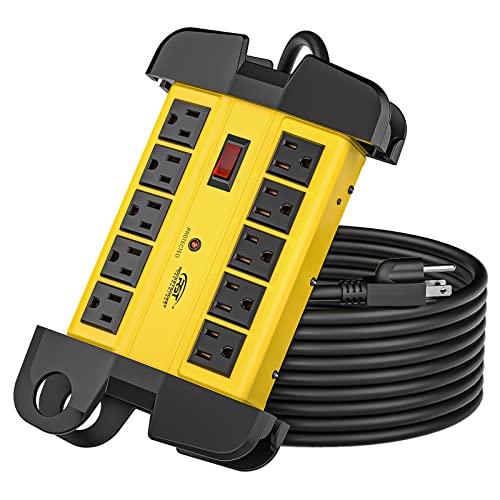
- 🔌 Outlets: 10 AC outlets
- ⚡ Surge Protection: 2,800 joules
- 🔒 Circuit Breaker: 15A resettable on/off breaker switch
- 📏 Cord Length: 15 feet, 14AWG heavy-duty
- 🏗️ Housing: Extruded aluminum alloy — impact resistant
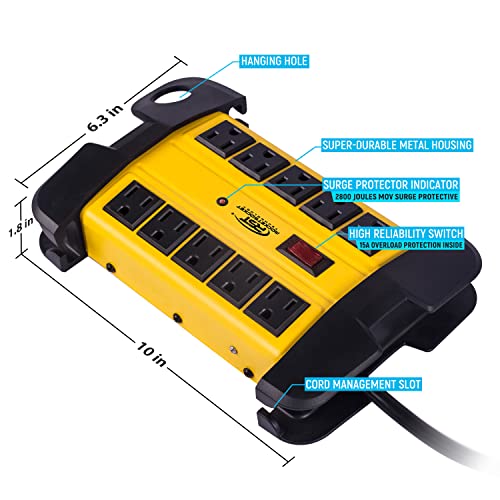
- 🧲 Mounting: Built-in keyholes + cord wrap + hanging hole
- 🏷️ Certification: ETL Listed (Intertek — OSHA-recognized NRTL)
- 📋 Rating: 15A / 125V / 1875W
- 💼 Insurance: $3,000,000 product liability
Editor’s Note
Most surge protectors in this roundup are designed for desks. The CRST is designed for the opposite: workshops, garages, construction sites, and any environment where a plastic housing would crack, a short cord would fall short, and a cheap breaker would be the last thing between your tools and an electrical fire.
The 15-foot cord is the headline feature — and it’s the longest in this entire roundup by a significant margin. In a garage or workshop where the wall outlet is behind a workbench or across the room, that reach eliminates the need for a separate extension cord entirely. The 14AWG copper wire is rated to carry the full 15A load stably and at low heat, which matters when you’re running multiple power tools simultaneously rather than just phone chargers.
The aluminum housing is not a cosmetic choice — it’s a functional one. Where plastic housings deform or melt under sustained heat from heavy loads, extruded aluminum dissipates heat and resists impact. The 15A circuit breaker trips automatically on overload, and the real-world evidence of that working comes from a verified California customer whose CRST strip automatically cut power when a connected extension cord overheated and began melting — containing the fault before it could reach the carpet directly underneath.
Pros
- 15-foot 14AWG cord — longest in this roundup; reaches across large rooms, garages, and workshops without an extension cord
- Extruded aluminum housing — impact-resistant, heat-dissipating metal construction built for harsh environments
- 2,800 joules ETL-certified surge protection — third-party verified, not self-declared
- 15A auto-tripping circuit breaker — resettable, with real verified overload performance
- Built-in cord wrap + mounting keyholes — stores neatly and mounts to walls or workbenches
- $3,000,000 product liability insurance — strongest coverage claim in this roundup
Cons
- No individual outlet switches — one master switch controls all 10 outlets
- Not weather resistant — must be used in dry environments only; not suitable for permanent outdoor or rain-exposed installation
- Industrial aesthetic — bright yellow housing is practical in a workshop but conspicuous in a home office
- Heavier and bulkier — the metal construction adds weight compared to slim plastic alternatives in this roundup
Can the CRST power strip be used outdoors?
Only in dry conditions. The CRST is not waterproof or IP-rated, and Amazon’s product page explicitly states it must be kept away from rain, water splashes, and humid environments. It can be used on a covered porch, in an open garage, or at an outdoor workstation in dry weather — but it should never be exposed to rain or left in a permanently damp environment.
Why We Liked It
The 15-foot cord solves a problem that no other pick in this roundup addresses. In a garage or workshop, the wall outlet is rarely where you need power. Most surge protectors offer 6 to 8 feet — just enough for a desk, not enough for a workbench 12 feet from the nearest outlet. The CRST’s 15-foot 14AWG cord brings power directly to the work area, and the integrated cord wrap keeps the slack managed when you don’t need all of it.
The aluminum housing is what separates the CRST from every other pick on this list. Drop it on a concrete floor, stack something on it, run it in a dusty environment — it handles conditions that would crack or warp a plastic housing. The ETL certification from Intertek (an OSHA-recognized lab) means that 2,800-joule surge rating has been independently verified, not printed on a box and hoped for.
Best For
Workshop, garage, and heavy-duty users who need the longest cord reach in the roundup, industrial-grade aluminum housing, and ETL-certified surge protection for power tools and heavy equipment in harsh environments.
CRST 10-Outlet Heavy Duty Metal Power Strip
The CRST 10-Outlet Heavy Duty Metal Power Strip is a workshop and garage surge protector — Best for Workshops & Garages — with a 15-foot 14AWG cord, extruded aluminum housing, 2,800 joules ETL-certified surge protection, and 15A resettable circuit breaker. The longest cord reach and most durable construction in the roundup.
Summary
The CRST earns its place as Best for Workshops & Garages through one combination no other pick in this roundup offers: a 15-foot 14AWG cord, extruded aluminum housing, and ETL-certified 2,800-joule surge protection. It gives up USB ports, individual outlet switches, and office aesthetics to deliver those three things. For workshop and garage users who need power where the wall outlet isn’t, this is the pick the rest of the list can’t replace.
Alestor 12-Outlet: Best for “Cable Nightmares” (Massive Capacity)

Quick Facts
- ⚡ 2700 joules surge protection — 3-level circuit (TVS + MOV + GDT)
- 🔌 12 AC outlets — 2 wide-spaced for bulky adapters, 10 standard
- 🔋 4 USB ports (1 USB-C + 3 USB-A) — smart auto-detect charging
- 📏 6ft heavy-duty extension cord for flexible desk placement
- 🛡️ ETL safety certified — fire-resistant PC shell, overload protection
- 🌍 120V–240V wide voltage range
Specifications
| Spec | Detail |
|---|---|
| Outlets | 12 AC |
| Joule Rating | 2700J |
| USB-C | 3A |
| USB-A | 3x 5V/2.4A |
| Cord Length | 6ft |
| Certification | ETL Listed |
| Warranty | 24-month |
Editor’s Note
ALESTOR is a Boise, Idaho-based brand founded in 2018 with a focused mission on power management solutions. The 12-outlet surge protector is their flagship product, and the numbers back it up — it one of the most purchased surge protectors on the market. What makes it stand out in this roundup is its 3-level complementary surge protection circuit — a technology typically found in premium models — delivered at a budget-friendly price.
Pros
- 2700J protection — highest joule rating in this roundup at this price
- 3-level surge circuit — TVS + MOV + GDT, more comprehensive than single-MOV competitors
- 12 outlets — 2 wide-spaced outlets handle bulky adapters without blocking neighbors
- 4 USB ports — smart auto-detect charging across USB-C and USB-A
- 6ft-20ft cord — extra foot of reach vs most competitors
Cons
- USB output shared — all 4 ports share 3.4A total, slows down with multiple devices
Why We Liked It
Independent testing confirmed the ALESTOR’s 2700 joule rating exceeded expectations for its price point, performing well in surge absorption tests — and its 3-level complementary circuit combining TVS, MOV, and GDT components is genuinely more sophisticated than the single-MOV designs found in most budget strips. For a home office with a mix of standard plugs and bulky charger bricks, the two wide-spaced outlets combined with ten standard ones means real-world flexibility without the frustration of blocked sockets.

ALESTOR 12-Outlet Surge Protector Power Strip
Best For: Budget-conscious home office users who need maximum outlets and high joule-rated surge protection in a single power strip without paying a premium price.
Summary
The ALESTOR delivers 2700 joules of 3-level surge protection and 12 well-spaced outlets at a price that undercuts almost every competitor in this roundup. It’s the rare budget product that punches above its weight on paper — and largely in practice too. Just be mindful that its 24-month warranty and ETL certification are solid, but independent long-term test data from major reviewers is limited. Buy it for everyday home office use — for high-value equipment, step up to the Anker 351 or Tripp Lite.
Belkin 12-Outlet 4,320 Joules Surge Protector — Best Protection

Quick Facts
- ⚡ Surge Protection: 4,320 joules — highest surge rating for higher protection
- 🔌 Outlets: 12 AC — 8 rotating + 4 fixed outlets for bulky power adapters
- 📏 Cord Length: 8FT heavy-duty extension cord with flat pivot plug
- 🛡️ Extra Protection: Coaxial cable + RJ11 phone/fax surge protection
- ⚙️ Power Rating: 125V • 15A • 1,875W with EMI/RFI noise filtering
- 🔥 Safety: UL Listed — 8-point protection system with fire-resistant housing
- 🏠 Design: Wall-mountable with rotating outlets for flexible cable management
- ✅ Warranty: 2-year warranty + $300,000 Connected Equipment Warranty
Editor’s Note
Most surge protectors compete by adding USB ports or extra outlets. Belkin took a different approach—build one of the highest-capacity surge protectors available for consumers. With a 4,320-joule rating, this strip is designed for people whose equipment costs far more than the power strip itself.
That makes it an excellent match for gaming PCs, NAS servers, home theaters, and professional workstations. The rotating outlets are more than a convenience—they solve one of the biggest frustrations with large power bricks, while the coaxial and phone-line protection is something many competing strips have quietly abandoned. If your priority is protecting expensive electronics rather than charging your phone, this Belkin earns its place.
Pros
- Highest surge protection in this roundup — 4,320 joules provides a larger safety margin than most consumer power strips
- 8 rotating outlets — oversized laptop bricks and adapters no longer block neighboring sockets
- Protects more than wall power — includes coaxial and telephone line surge protection for complete entertainment or networking setups
- Excellent for high-value equipment — ideal for gaming PCs, NAS servers, OLED TVs, workstations and AV systems
- 8-foot flat-plug cord — easier placement behind desks, cabinets and entertainment centers
- $300,000 Connected Equipment Warranty — among the strongest protection guarantees in this category
- UL Listed construction — independently certified safety backed by Belkin’s long reputation in power protection
Cons
- No built-in USB charging — every outlet is dedicated to AC devices
- Large footprint — requires more space than compact surge protectors
- Overkill for basic setups — unnecessary if you’re only powering lamps or phone chargers
Why We Liked It
Many manufacturers advertise how many outlets their power strip has. Belkin instead focuses on how much abuse it can absorb before your equipment does. A 4,320-joule rating places it among the highest-capacity consumer surge protectors available today, making it a reassuring choice for expensive electronics that would cost hundreds—or thousands—to replace.
The rotating outlet design is another feature that proves its value every day. Large laptop chargers, gaming power supplies, and monitor adapters fit without blocking adjacent sockets, eliminating the frustrating “outlet Tetris” common with cheaper strips. Add an 8-foot cord, UL certification, coaxial and phone-line protection, and Belkin’s $300,000 Connected Equipment Warranty, and you get a surge protector designed for people who value protection above everything else.
Best For
Users protecting expensive electronics rather than simply adding more outlets. Ideal for gaming PCs, NAS servers, home theaters, multi-monitor workstations, and networking equipment where maximum surge protection is a higher priority than built-in USB charging.

Belkin 12-Outlet Surge Protector Power Strip
The Belkin 12-Outlet Surge Protector delivers 4,320 joules of surge protection—the highest rating in this roundup—along with 12 AC outlets, eight rotating sockets, an 8-foot cord, and coaxial and phone-line protection. It’s designed for users who want serious protection for valuable electronics rather than just another extension cord.
Summary
The Belkin 12-Outlet Surge Protector earns our Best Protection award thanks to its outstanding 4,320-joule surge rating, flexible rotating outlets, and comprehensive protection features backed by a $300,000 Connected Equipment Warranty. It lacks USB charging, but if safeguarding expensive equipment is your top priority, this is one of the strongest surge protectors you can buy.
Tripp Lite TLP1208: Industrial-Grade Shielding for High-End Tech

Quick Facts
- ⚡ 2160 joules surge protection — UL 1449 4th Edition certified
- 🔌 12 AC outlets — 4 wide-spaced transformer outlets + 8 standard
- 📏 8ft flat plug extension cord — fits flush behind furniture and cabinets
- 🔇 EMI/RFI noise filtering — cleaner power for sensitive equipment
- 🛡️ $150,000 Ultimate Lifetime Insurance — highest equipment coverage in this roundup
- 🔒 Auto-shutoff — cuts power completely when surge protection is exhausted
Specifications
| Spec | Detail |
|---|---|
| Outlets | 12 AC |
| Joule Rating | 2160J |
| USB Ports | None |
| Cord Length | 8ft |
| Clamping Voltage | 330V (UL1449) |
| Certification | UL Listed |
| Warranty | Lifetime + $150K equipment |
Editor’s Note
Tripp Lite — now part of Eaton, one of the world’s largest power management companies — has built its reputation on protecting workstations, PCs, and telecom systems for decades. The TLP1208TELTV is the product that carries that reputation most visibly: Wirecutter named it a top surge protector pick and independent testing across 16 surge protectors selected it as the overall top pick, citing its auto-shutoff feature, outlet layout, and equipment warranty. Backed by thousands of verified buyers and one of the most recognized names in power protection, this is the strip you buy when protection is the only priority.
Pros
- Auto-shutoff — cuts power when MOVs are exhausted, actively prevents damage
- $150,000 equipment warranty — highest coverage in this roundup by far
- UL 1449 4th Edition — most current and stringent UL certification available
- 8ft flat plug cord — maximum reach with flush-wall placement
- Wirecutter & independent lab tested — verified by major reviewers, not just spec sheets
Cons
- No USB ports — no built-in charging for phones or tablets
- Outlet spacing — 8 standard outlets are closely spaced, fitting a 12th bulky plug is tight
- Premium price — most expensive pick in this roundup
Why We Liked It
What genuinely separates the Tripp Lite from every other strip in this roundup is its auto-shutoff behavior. Most surge protectors continue supplying power even after their internal MOVs are worn out — leaving you with false protection and no warning. The TLP1208TELTV cuts power completely when its internal protection can no longer absorb surges — a critical safety feature that Tripp Lite states clearly in their documentation. For a home office running irreplaceable data on hard drives, or expensive equipment that can’t be easily replaced, this distinction matters enormously. Real-world users report the strip successfully protecting TVs, receivers, and electronics through actual lightning surge events — not just lab tests.
The honest trade-off is simplicity: no USB ports and closely spaced standard outlets mean it’s not the most convenient daily-use strip. Independent testing confirmed that fitting a 12th plug on the standard-spacing side is too tight for most bulky adapters — realistically, treat it as an 11-outlet strip. For a home office where maximum protection and a trusted warranty matter more than USB charging convenience, those are easy trade-offs to accept.

Eaton Tripp Lite TLP1208TELTV Surge Protector Power Strip
Best For: Home office users with high-value equipment who need the most reliable surge protector power strip in the roundup — and want a $150,000 equipment warranty and auto-shutoff protection to back it up.
Summary
The Tripp Lite TLP1208TELTV is the heavy-duty surge protector power strip for home office users who refuse to compromise on protection. Wirecutter-tested, UL 1449 4th Edition certified, and backed by a $150,000 lifetime equipment warranty, it’s the only strip in this roundup that actively cuts power when its protection runs out — not just lights up a warning. If you’re protecting a high-value workstation, irreplaceable data, or expensive peripherals, this is the strip worth investing in.
BSEED Single Outlet Voltage Protector — Best for Large Appliances

Quick Facts
- 🏢 Brand — BSEED, a dedicated appliance protection specialist with 50,000+ customers across their voltage protector lineup
- 📐 Fit — Single outlet; plugs directly into wall; designed for refrigerators, freezers, washing machines, air conditioners, ice makers
- ⚡ Surge Rating — 1,050 Joules
- 🔒 Protection — overvoltage, undervoltage, brownout, voltage spike, voltage fluctuation, and load shedding — 6-mode protection
- ⏱️ Delay Function — 3-minute stabilisation delay before re-establishing power after voltage event; protects compressor motors from restart damage
- 📊 LED Indicators — 4 status lights: Normal (Output), High (Overvoltage), Low (Undervoltage), Delay
- 🔥 Shell — 1,382°F fire-resistance PC flame retardant housing
- ⚡ Capacity — 1,875W / 125V / 15A
- 📅 Warranty — 3 years + 24/7 customer service + no-questions return policy
- 📏 Dimensions — 2.56″L × 3.94″W; 0.35 lbs
Editor’s Note
Every other pick in this roundup is a multi-outlet power strip designed for desks, home offices, and entertainment centres. The BSEED is something categorically different — a single-outlet voltage protector built specifically for large appliances, and it solves a problem that a standard surge protector simply cannot address.
The distinction worth understanding is brownout protection. A standard surge protector responds to overvoltage spikes — the kind that come from lightning strikes or grid fluctuations that push voltage too high. What it doesn’t protect against is undervoltage: the slow voltage sag that happens during peak demand periods, when the grid is under strain, or in older buildings with inconsistent wiring. Refrigerator and washing machine compressor motors are particularly vulnerable to undervoltage — running a compressor at reduced voltage generates excess heat, accelerates motor wear, and shortens appliance lifespan significantly. The BSEED monitors both directions: it cuts power when voltage goes too high and when it drops too low.
The 3-minute delay function is the feature I find most practically useful. When power is restored after an outage or voltage event, the BSEED waits 3 minutes before re-establishing current to the appliance. This isn’t arbitrary — refrigerator and AC compressors need a pressure equalisation period before restarting safely. Restarting a compressor immediately after a power cut is one of the most common causes of compressor failure. The BSEED handles this automatically without any user intervention.
Pros
- 6-mode voltage protection — overvoltage, undervoltage, brownout, voltage spike, voltage fluctuation, and load shedding; the most comprehensive voltage monitoring in this roundup
- 3-minute compressor delay — automatically waits 3 minutes before re-establishing power after a voltage event; prevents compressor restart damage on refrigerators and AC units
- 4 LED status indicators — Normal, High, Low, and Delay; real-time voltage status visible at a glance without any monitoring app or display required
- 1,382°F fire-resistance PC shell — flame retardant housing independently rated; meaningful safety feature for a device running continuously behind a refrigerator or washing machine
- 1,875W / 15A capacity — handles large appliances including full-size refrigerators, washing machines, and air conditioners within the rated load
- 3-year warranty + no-questions return — the longest warranty period in this roundup; backed by 24/7 customer service
- Compact 0.35 lb form factor — plugs directly into the wall behind the appliance; no cord management required
Cons
- Single outlet only — protects one appliance at a time; buyers who need multi-device protection need a separate pick from this roundup
- 1,050 Joule surge rating — lower than multi-outlet picks in this roundup; the primary value is voltage monitoring and brownout protection, not raw surge joule capacity
- 3-minute delay requires patience — after every power event, the appliance won’t restart for 3 minutes; intentional by design but worth knowing before purchase
- Not suitable for sensitive electronics — designed for large motor-driven appliances; buyers protecting computers, TVs, or audio equipment should look at other picks in this roundup
Do I need a voltage protector if I already have a whole-house surge protector installed?
Whole-house surge protectors handle high-voltage spikes at the electrical panel — they’re excellent at stopping large transient events like lightning strikes from reaching your wiring. What they don’t monitor is undervoltage and brownout — gradual voltage sag that occurs during peak demand or grid strain. A whole-house protector won’t cut power to your refrigerator if the voltage drops to 90V during a hot summer afternoon when demand is high. The BSEED addresses this gap specifically — it monitors voltage continuously at the outlet level and responds to both over and under-voltage conditions that a panel-mounted device doesn’t catch. The two systems complement rather than duplicate each other.
Why We Liked It
The honest argument for the BSEED is that large appliances fail from voltage problems that standard surge protectors ignore. Refrigerator compressor failure, washing machine motor burnout, and AC unit damage from voltage fluctuations are among the most expensive home appliance repair bills — and the root cause is often chronic undervoltage or repeated restart-without-delay events rather than a single dramatic surge. The BSEED addresses all of these simultaneously for under $20.
The 4 LED status display is more useful than it sounds — after installation, a quick glance tells you whether your refrigerator is receiving normal voltage, whether it’s in a delay cycle, or whether the grid is currently running high or low. That’s real-time information that most homeowners never have about their appliance power quality. For anyone who has lost a refrigerator, washing machine, or AC unit to an unexplained compressor failure, the BSEED Single Outlet Voltage Protector is a straightforward insurance policy against it happening again.
Best For
Homeowners who want continuous voltage monitoring and brownout protection for refrigerators, washing machines, air conditioners, and other large motor-driven appliances — with automatic 3-minute compressor delay built in.

BSEED Single Outlet Voltage Protector
The BSEED Single Outlet Voltage Protector is a large appliance surge and voltage protector — Best for Large Appliances — with 6-mode voltage protection including brownout and undervoltage monitoring, a 3-minute compressor delay, 4 LED status indicators, and a 3-year warranty.
Summary
The BSEED earns Best for Large Appliances by addressing overvoltage, undervoltage, brownout, and compressor restart damage in a single compact outlet protector — problems that every other pick in this roundup doesn’t cover. 1,050 Joules, 3-minute compressor delay, 4 LED indicators, 1,382°F fire-resistant shell, and a 3-year warranty at under $20. The pick for anyone who wants to protect their most expensive home appliances from the voltage problems that actually cause them to fail.
Anker 341 Power Strip Surge Protector — Best Mid-Range Pick

Quick Facts
- ⚡ 2000 joules surge protection — TUV certified, 8-point safety system
- 🔌 8 AC outlets across 3-sided layout — no blocked sockets
- 🚀 20W USB-C fast charges iPhone to 50% in 26 minutes
- 🔋 2 USB-A ports for headphones, smartwatches, and smaller devices
- 📏 5ft flat plug — 45° angle fits behind furniture and nightstands
- 🧲 Wall mountable — 2 mounting slots included
Specifications
| Spec | Detail |
|---|---|
| Outlets | 8 AC |
| Joule Rating | 2000J |
| USB-C | 20W (PD) |
| USB-A | 2x 5V/2.4A |
| Cord Length | 5ft |
| Dimensions | 4.5 × 3.6 × 1.6 in |
| Certification | TUV Listed |
| Warranty | 18-month + $20K equipment |
Editor’s Note
Anker is the world’s best-selling mobile charging brand — and the 341 is their compact, focused answer to the question of how much power strip you actually need for a standard room setup. Available at Best Buy, Newegg, and Amazon, it carries the same TUV certification and 8-point safety system as Anker’s flagship 351, in a smaller 8-outlet footprint. Backed by thousands of verified buyers across multiple retail channels, the 341 sits in a sweet spot that many home office users will find is exactly enough — without paying for outlets they’ll never use.
Pros
- 2000J TUV certified — same safety pedigree as the flagship Anker 351
- 3-sided outlet layout — eliminates blocked socket frustration entirely
- 20W USB-C — genuine fast charging built into a compact strip
- 45° flat plug — fits flush behind furniture and tight wall gaps
- Compact size — smaller footprint than 12-outlet strips, ideal for desks and nightstands
Cons
- $20,000 equipment warranty — significantly lower than Anker 351’s $200,000 coverage
- USB output shared — all ports drop to 15W when used simultaneously
- 8 outlets only — may feel limiting for fully loaded desk setups
Why We Liked It
The Anker 341 makes the most compelling case for right-sizing your power strip. For a bedroom nightstand, a small home office desk, or a dorm room setup, 12 outlets is overkill — and paying for them means paying for bulk you don’t need. The 3-sided outlet layout in a compact 4.5-inch body delivers the same blocked-adapter-free experience as larger strips, and the 45° flat plug genuinely disappears behind furniture in a way standard plugs can’t. Real-world users consistently highlight the combination of compact size and thoughtful layout as the strip’s defining strength.
The most important honest comparison is against its sibling, the Anker 351: the 341 carries the same TUV certification and 20W USB-C charging, but its $20,000 equipment warranty is a tenth of the 351’s $200,000 coverage. For a nightstand charging phones and earbuds, that’s an easy trade-off. For a desk running a laptop, monitor, and external drives, the warranty gap is worth the step up to the 351.

Anker 341 Power Strip Surge Protector
Best For: Home office and bedroom users who want Anker’s trusted surge protection in a compact power strip — without the bulk of a 12-outlet strip they’ll never fill.
Summary
The Anker 341 delivers 2000 joules of TUV-certified surge protection, a 20W USB-C fast charging port, and a 3-sided outlet layout in one of the most compact footprints in this roundup. It’s the right choice for users who don’t need 12 outlets but still want Anker’s build quality and safety credentials. Just be aware the $20,000 equipment warranty is a step down from the flagship 351 — factor that in if you’re protecting higher-value devices.
Belkin 6-Outlet 360° Rotating Plug — Best for Tight Spaces

Quick Facts
- 🏢 Brand — Belkin, a globally trusted accessories brand with a dedicated surge protection lineup and multi-decade track record
- 📐 Design — 360° rotating flat plug; swivels to any angle for outlets behind furniture, in tight corners, or awkward wall positions
- 🔒 Surge Rating — 1,080 Joules; 3-line AC protection
- 🔌 Outlets — 6 surge-protected AC outlets; widely spaced to accommodate larger power adapters and charger bricks
- 📻 EMI/RFI Filtering — up to 43dB electromagnetic and radio frequency interference reduction
- 🔥 Safety — 6-point safety system: fire resistant material, overcurrent, overload, short circuit, clamping, and 3-line AC protection; UL safety certified
- 📏 Cord — 6ft cord
- 💰 Warranty — 2-year product warranty + $15,000 Connected Equipment Warranty
Editor’s Note
The outlet behind the sofa, the socket half-blocked by the entertainment unit, the wall plug that faces the wrong direction for the power strip to lie flat — these are the everyday frustrations that a standard fixed-plug surge protector can’t solve without pulling furniture away from the wall. The Belkin 6-Outlet Surge Protector’s 360-degree rotating plug was specifically designed to fit easily into tight spaces and behind furniture, and that single feature solves the placement problem that makes most surge protectors awkward in real living spaces.
I think the rotating plug is underappreciated as a design decision. It’s not just about aesthetics — a fixed-direction plug in a tight space forces the cord to bend at an angle that stresses both the plug and the outlet over time. A rotating plug lets the cord exit at whatever angle works for the space, eliminating that stress point entirely. Independent reviewers consistently highlight the 360° rotating flat plug as the defining feature — noting it solves outlet placement problems that other surge protectors can’t address without moving furniture.
The 43dB EMI/RFI filtering is worth noting specifically — it reduces electromagnetic and radio frequency interference on the power line, which matters for audio equipment, broadband modems, and sensitive electronics that pick up line noise as hum, interference, or performance degradation. Most basic surge protectors don’t include power filtration at this level. The UL safety certification and Belkin’s $15,000 Connected Equipment Warranty round out a package that’s backed by one of the most established names in consumer electronics accessories.
Pros
- 360° rotating flat plug — swivels to any angle; fits flush behind furniture, in corners, and against walls where fixed plugs create clearance problems or cord stress
- 6 widely-spaced outlets — accommodates larger power adapters and charger bricks without blocking adjacent outlets; practical for real-world mixed-plug setups
- 43dB EMI/RFI filtering — reduces electromagnetic and radio frequency interference; meaningful for audio equipment, modems, and sensitive electronics on the same circuit
- UL safety certified — independently tested and verified by an accredited US safety laboratory
- 6-point safety system — fire resistant material, overcurrent, overload, short circuit, clamping, and 3-line AC protection
- $15,000 Connected Equipment Warranty — Belkin repairs or replaces equipment damaged while properly connected
- Belkin brand reliability — decades of consumer electronics track record; consistent build quality across generations
Cons
- 1,080 Joules — the lowest surge joule rating among multi-outlet picks in this roundup; adequate for everyday electronics but significantly below the Belkin 12-outlet’s 4,320J or ALESTOR’s 2,700J for high-value equipment
- 6 outlets only — fewer than most other picks in this roundup; buyers who need 10-12 outlets should look at ALESTOR or Eaton Tripp Lite
- $15,000 Connected Equipment Warranty — lower than Anker’s $200,000 and Belkin’s own 12-outlet $300,000 warranty
- 1,080J limits suitability for high-value electronics — computers, NAS drives, and audio equipment benefit from higher joule ratings available elsewhere in this roundup
Does the rotating plug affect the surge protector’s electrical performance — or is it purely mechanical?
The rotating mechanism is purely mechanical — it changes the physical orientation of the plug without affecting the electrical path or surge protection circuitry inside the unit. The 1,080J surge rating, 3-line AC protection, and EMI/RFI filtering all function identically regardless of which angle the plug is rotated to. The only consideration is ensuring the plug makes full contact with the outlet at whatever angle is chosen — a partial insertion at an awkward angle reduces contact quality, so always confirm the plug is fully seated before use.
Why We Liked It
CDW’s reviewer specifically highlighted the 360° rotating plug as solving outlet placement problems for electronics in tight spaces — and that real-world utility is exactly what earns this the Best for Tight Spaces label. The 43dB EMI/RFI filtering is a genuine addition that most basic surge protectors skip, and Belkin’s UL certification and $15,000 Connected Equipment Warranty provide the brand assurance that budget rotating-plug alternatives typically can’t match
The honest trade-off is the 1,080J surge rating — it’s adequate for the everyday electronics this strip is designed for, but buyers protecting high-value computers or audio equipment should step up to the Anker 351 or Belkin 12-outlet for stronger joule protection. For everyone else who needs a Belkin-quality surge protector that actually fits the outlet they have, the Belkin 6-Outlet 360° Rotating Plug solves the problem cleanly.
Best For
Anyone who needs a surge protector for outlets behind furniture, in corners, or in awkward positions — where a fixed-direction plug creates clearance issues or forces furniture away from the wall.

Belkin 6-Outlet 360° Rotating Plug
The Belkin 6-Outlet 360° Rotating Plug is a surge protector for tight spaces — Best for Tight Spaces — with a 360° rotating flat plug, 1,080 Joules of surge protection, 43dB EMI/RFI filtering, UL certification, and a $15,000 Connected Equipment Warranty.
Summary
The Belkin 6-Outlet 360° Rotating Plug earns Best for Tight Spaces through its 360° swivelling flat plug, 43dB EMI/RFI filtering, UL certification, and $15,000 Connected Equipment Warranty — from a brand with decades of accessory track record. At 1,080J it’s not the strongest surge protector in this roundup, and 6 outlets won’t cover a complex desk setup. For the outlet that’s half-hidden behind furniture, nothing else here solves the placement problem as cleanly.
Can a Surge Protector Protect Against Lightning?
This is one of the most common misconceptions about surge protectors.
The short answer is yes—but only to a point.
A plug-in surge protector like this Belkin is designed to absorb everyday power surges, including utility switching events, small grid disturbances, and minor voltage spikes that occur much more often than direct lightning strikes. These small surges gradually wear down electronic components over time, and that’s exactly what surge protectors are built to defend against.
A direct lightning strike, however, is a completely different event. It can involve hundreds of thousands of joules of energy—far beyond what any plug-in surge protector is designed to absorb. No reputable manufacturer claims that a Type 3 surge protector can stop a direct lightning strike.
For homes in areas with frequent thunderstorms, electricians typically recommend a layered protection strategy:
- Type 1 Surge Protector – Installed at the utility service entrance to protect the entire home.
- Type 2 Surge Protector – Installed at the main electrical panel to reduce large incoming surges before they reach branch circuits.
- Type 3 Surge Protector – Plug-in devices like this Belkin, APC, or Anker model that provide the final layer of protection for sensitive electronics.
Think of it like security for your home. The front gate, the front door, and the lock on your office each serve a different purpose. None replaces the others—they work together.
For most homes, a quality plug-in surge protector is still an important investment because small and moderate power surges are far more common than direct lightning strikes. If you live in an area with frequent severe storms, pairing a whole-house surge protector with a high-quality plug-in model provides the most comprehensive protection.
Safety Checklist
The “Joule” Count: How Much Protection is Enough?
The joule rating tells you how much surge energy a strip can absorb before its protection wears out. A higher number means more protection and longer lifespan. For a basic nightstand or dorm room setup, 900–1500 joules is acceptable. For a home office running a desktop, monitor, and external drives, aim for 2000 joules minimum. For high-value workstations or irreplaceable equipment, 2500 joules and above is the safest choice.
Certifications — Don’t Skip This
A surge protector is only as trustworthy as its certification. Look for UL, ETL, or TUV listing on the box — these mean an independent lab has physically tested the product against safety standards. A strip without one of these certifications is an untested claim, not a verified product. Every pick in this roundup carries at least one recognized safety certification.
Outlet Count and Spacing
Twelve outlets sounds like plenty — until two bulky laptop chargers block four of them. Always check whether the strip has wide-spaced or transformer outlets designed to accommodate large adapters without blocking neighbors. A well-designed 8-outlet strip with smart spacing will outperform a poorly designed 12-outlet strip in real daily use.
USB-C Charging: Can It Replace Your Phone Brick?
Most modern surge protectors include USB charging ports, but not all USB ports are equal. Basic USB-A ports handle phones and earbuds. A USB-C port with Power Delivery (PD) fast charges iPhones, iPads, and Android devices significantly faster. If fast charging matters to you, confirm the USB-C port is rated at 18W minimum — preferably 20W or above.
The “2-Year Rule”: Why You Might Need to Replace Your Current Strip
Most people don’t realize that surge protection wears out. Every small power spike eats away at the “Joules.” If your current protector is more than 3 years old, it’s likely just a regular power strip now with zero protection.
The $50,000 Warranty: Does It Actually Pay Out?
The best surge protectors back their protection claims with a connected equipment warranty — meaning if a surge damages your devices while plugged in, the manufacturer covers the repair or replacement cost. These range from $20,000 to $150,000 across picks in this roundup. A strip without an equipment warranty is a manufacturer not confident in their own product.
Auto-Shutoff
Most people don’t know that surge protector MOVs — the components that absorb surges — wear out over time. A basic strip will continue supplying power even after its protection is exhausted, giving you false security. Strips with auto-shutoff cut power completely when protection runs out, actively preventing damage. Only one pick in this roundup has this feature — and it’s worth knowing which one.
Tips for Getting the Most from Your Surge Protector Power Strip
Always Check for a Joule Rating — If It’s Not There, It’s Not a Surge Protector — This is the single most important rule when buying a power strip. A strip without a published joule rating offers zero surge protection — it’s just an extension cord with extra outlets. Every product in this roundup publishes its joule rating clearly. If you’re shopping outside this list, no joule rating on the box means no protection, full stop.
Replace Your Surge Protector Every 3–5 Years — Surge protectors don’t last forever. The internal MOV components that absorb surges wear out gradually with every spike and fluctuation — even ones too small to notice. A strip that’s been in use for years may look fine but offer no real protection at all. If your strip has survived a significant lightning event or power outage, replace it immediately regardless of age.
Match Your Joule Rating to What You’re Protecting — Not every device needs maximum protection. For phones, lamps, and small appliances, 900–1500 joules is sufficient. For computers, monitors, and external drives, aim for 2000 joules minimum. For high-value workstations, NAS devices, or irreplaceable equipment, choose 2500 joules and above — the Belkin or Eaton Tripp Lite are the right choices here.
Plug Into the Wall Directly — Never Daisy-Chain — Connecting one surge protector into another is a fire hazard and voids most manufacturer warranties immediately. Every strip in this roundup is designed to connect directly to a wall outlet. If you need more outlets than a single strip provides, install an additional wall outlet rather than stacking strips.
Outlet Spacing Matters More Than Outlet Count — A 12-outlet strip sounds like twice the value of a 6-outlet strip — until bulky laptop chargers and power bricks block half the sockets. Before buying, check whether the strip has dedicated wide-spaced or transformer outlets designed for large adapters. The Anker 351 and ALESTOR both address this directly — the HANYCONY’s 2.2in spacing is the widest in this roundup.
USB-C Port Wattage Is Not Equal Across Strips — Most surge protectors advertise USB-C charging without mentioning the wattage. A 5W USB-C port charges a phone barely faster than a standard USB-A port. A 20W USB-C Power Delivery port like those on the Anker 351 and Anker 341 charges an iPhone to 50% in under 30 minutes. Always check the wattage before assuming a USB-C port is fast.
The Equipment Warranty Is the Manufacturer’s Confidence Signal — A connected equipment warranty means the manufacturer will cover repair or replacement costs if a surge damages your devices while plugged in. Ranges vary significantly — from $20,000 on the Anker 341 to $150,000 on the Eaton Tripp Lite. A strip with no equipment warranty is a manufacturer unwilling to back their own protection claims. Factor this into your decision especially for high-value equipment.
Pro Tip: Reuse Your Old Surge Protectors – When your surge protector “expires” (reaches its Joule limit), don’t throw it away! It still works perfectly as a basic power strip. Move it to a low-risk area to power your lamps, fans, or alarm clocks—items that don’t have sensitive microchips and don’t need surge protection. Just keep your PCs and TVs on the new, “fresh” units.
Editor’s Tip — Don’t buy a surge protector based on outlet count alone. A 12-outlet strip with 900 joules and no certification will protect your devices less effectively than an 8-outlet strip with 2500 joules and a UL listing. Match the joule rating and certification to what you’re actually plugging in — and the outlet count to what you actually need — and you’ll get full value from every pick in this roundup.
Frequently Asked Questions Surge Protector Power Strip
What is the difference between a surge protector and a power strip?
They look almost identical on a shelf — but they do fundamentally different jobs. A power strip simply adds extra outlet space, while a surge protector defends against voltage spikes that could damage your electronics. The easiest way to tell them apart is the joule rating: only surge protectors carry a joule rating on their packaging — a plain power strip won’t have one because it has nothing to rate. If you’re plugging in a computer, monitor, or any device you’d be upset to lose, always verify you’re buying a certified surge protector, not just a multi-outlet extension cord with a power switch.
How many joules do I actually need?
The honest answer depends entirely on what you’re protecting. For most electronics and devices, 2000 joules and above is more than adequate protection — and that’s the minimum we’d recommend for any home office setup running a computer and monitor. For a nightstand or light device charging, 900–1500 joules handles everyday use comfortably. For high-value workstations, NAS drives, or irreplaceable equipment, aim for 2500 joules and above — and pair it with a strip that carries a connected equipment warranty. One important caveat: a single lightning strike releases an enormous amount of energy almost instantly — no consumer surge protector absorbs a direct strike.
Do surge protectors wear out — and how do I know when to replace mine?
Yes — and this is the most overlooked fact about surge protectors. The MOV components inside a surge protector wear out gradually as they absorb surges, and a good rule of thumb is to replace your surge protector every three to five years. The problem is that a worn-out strip looks and functions exactly like a working one — it still powers your devices, it just no longer protects them. Strips with a protection indicator LED solve this partially by confirming active protection is still working. Strips with auto-shutoff go further — cutting power completely when protection is exhausted rather than leaving you with false security. If your strip has survived a significant power surge or lightning event, replace it immediately regardless of age.
Can I plug a surge protector into another surge protector?
No — and this is more dangerous than most people realize. Surge protectors are designed to connect directly to a wall outlet, and daisy-chaining two strips together creates a fire hazard by potentially overloading the circuit beyond its rated capacity. It also voids the manufacturer warranty on both strips immediately in most cases. If you need more outlets than a single strip provides, the right solution is installing an additional wall outlet or using a strip with a higher outlet count. Every pick in this roundup is designed for direct wall connection only.
Is a surge protector necessary if my devices already have built-in protection?
It’s a fair question — and the honest answer is: built-in protection is not enough on its own. Almost all electronics have some surge protection built in, but an external surge protector adds an additional layer of defense on top of that. Think of it as wearing both a seatbelt and having an airbag — each layer independently reduces risk. Built-in device protection is designed for minor everyday fluctuations. An external surge protector absorbs the larger spikes before they even reach your device’s internal components — extending equipment lifespan and providing a connected equipment warranty that your device’s built-in protection never will. For a home office running equipment worth hundreds or thousands of dollars, the cost of a certified surge protector is genuinely negligible by comparison.
Will a surge protector keep my devices safe from voltage fluctuations?
Partially — and understanding the distinction could save your equipment. Surge protectors are designed specifically for instantaneous voltage spikes — sudden high-voltage events like lightning strikes or grid switching that last microseconds. Voltage fluctuations, on the other hand, are long-term instability events — brownouts, undervoltage, or persistent overvoltage that last seconds, minutes, or even hours. A surge protector handles the first category well. For the second, it offers limited or no protection at all.
A long-term overvoltage surge lasting seconds, minutes, or hours — caused by power transformer failures or utility errors — is not protected against by standard transient surge protectors. These long-term surges can actually destroy the protectors themselves. This is an important limitation that most product listings don’t mention clearly. If you live in an area with frequent brownouts, unstable grid voltage, or unreliable power supply — common in many parts of the world — a standard surge protector is not sufficient on its own.
For comprehensive protection against both spikes and long-term fluctuations, the recommended approach is to use both devices together: a surge protector for instantaneous spike protection, and a voltage protector or UPS (Uninterruptible Power Supply) for persistent voltage instability. A UPS is particularly valuable for computers and sensitive electronics — it provides battery backup during outages and actively stabilizes voltage levels, covering the scenarios a surge protector alone cannot. For a home office running equipment you can’t afford to lose, pairing a quality surge protector power strip from this roundup with a UPS is the most complete protection strategy available.
What is the difference between a surge protector and an extension cord?
They look almost identical on a shelf — but they serve completely different purposes. An extension cord simply extends the reach of a wall outlet, adding length and sometimes extra sockets. It offers zero protection against voltage spikes, power surges, or electrical faults. A surge protector does everything an extension cord does, but adds a critical layer of defence: internal components — typically MOV (Metal Oxide Varistor) chips — absorb excess voltage before it reaches your connected devices.
The easiest way to tell them apart is the joule rating. Every genuine surge protector publishes a joule rating on its packaging — a number that represents how much surge energy it can absorb. An extension cord has no joule rating because it has nothing to rate. If you’re plugging in a computer, monitor, TV, or any device you’d be upset to lose, a surge protector is the correct choice. An extension cord alone offers no protection whatsoever — and in a surge event, it simply conducts the damaging voltage straight into your equipment.
Every pick in this roundup is a certified surge protector with a published joule rating. If reach is your primary concern, several picks here — including the Belkin 8-outlet with its 8FT cord — offer longer cables than most standard extension cords anyway.
Written by Metin Karal
Metin Karal is a Computer Engineer with over 25 years of experience working with internet technologies, trends, and digital tools since 1995. He brings this deep background into his product reviews, combining technical expertise with careful research to deliver honest, practical insights for readers. Passionate about technology, Metin also enjoys programming in C# and is currently developing PairMem, a challenging memory game available for free on the official Microsoft Store.
How We Selected These Products
We recommend these items based on a thorough research process designed to highlight the best options available. While we did not physically test some products ourselves, we relied on detailed research and verified customer feedback to evaluate them.
- Detailed Research: We reviewed product specifications, manufacturer information, and feature lists to understand what each item offers.
- Customer Insights: We analyzed verified buyer reviews and ratings to learn how these products perform in real-world use.
- Comparison Factors: We compared products across price, durability, usability, and unique features to identify the strongest choices.
- Personal Experience: With over 25 years of working in internet-related technologies and following online trends since 1995, I bring a deep understanding of how products are marketed, evaluated, and used. This background helps me filter out hype and focus on what truly matters for everyday users.
- Balanced Evaluation: Our goal is to provide clear, unbiased information so you can make confident purchasing decisions.
See also How We Review Products section for more details on our process.